Cyberattacks can move from a single compromised endpoint to multiple systems before security teams understand what is happening. Traditional antivirus alone may not provide the visibility and investigation capabilities needed to identify every suspicious activity.
Endpoint detection and response (EDR) helps organizations monitor endpoints, investigate potential threats and respond to malicious activity. This guide explains how EDR software works, which capabilities matter, and how businesses can evaluate EDR solutions as part of a broader cybersecurity strategy.
See how CyberSIO helps strengthen your security posture: Schedule a Free Demo.
What Is Endpoint Detection and Response?
Endpoint detection and response is a cybersecurity approach that continuously monitors devices such as laptops, desktops and servers for suspicious behaviour. It collects endpoint activity data and uses detection rules, behavioural analytics and threat intelligence to identify potential attacks.
Unlike traditional antivirus, which primarily focuses on preventing known malicious files, EDR security tools can help analysts investigate suspicious processes, trace attack activity and contain affected devices.
Common endpoints include:
- Employee laptops and workstations
- Business-critical servers
- Remote and hybrid-work devices
- Supported cloud workloads
Also read: Network Access Control (NAC): The Foundation of Modern Enterprise Security
How EDR Software Works
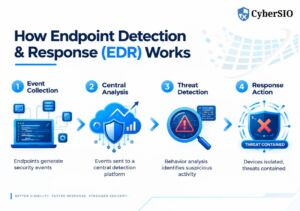
EDR software typically operates through endpoint agents that collect telemetry and send relevant events to a central security platform. Detection engines analyse this activity, generate alerts and support investigation and response.
Core EDR capabilities
- Continuous monitoring: Tracks processes, file activity, network connections and other endpoint events.
- Threat detection: Identifies suspicious behaviour, malware and attack patterns.
- Investigation: Helps analysts reconstruct activity and understand the scope of an incident.
- Threat containment: Supports actions such as isolating an affected endpoint or terminating a malicious process.
- Threat hunting: Enables security teams to search for indicators of compromise and suspicious activity.
For example, if a workstation launches an unusual script, attempts credential theft and connects to a suspicious server, an EDR tool may correlate these events, alert the SOC team and support containment.
Also read: What Is ITDR? Identity Threat Detection and Response Explained
EDR vs. Traditional Antivirus
| Capability | Traditional antivirus | EDR software |
| Primary focus | Malware prevention and detection | Endpoint visibility, detection and response |
| Behaviour analysis | Varies by product | Commonly a core capability |
| Investigation | Generally more limited | Detailed event and incident investigation |
| Response | Blocking or removing threats | May include isolation and process termination |
| Threat hunting | Limited or product-dependent | Often supports advanced hunting |
The capabilities of both categories vary by vendor. Modern antivirus products can also include behavioural detection and endpoint response features.
Why EDR Security Matters in 2026
Attackers increasingly rely on legitimate tools, stolen credentials and techniques that may not involve conventional malware.
CrowdStrike’s 2026 Global Threat Report found that the average eCrime breakout time fell to 29 minutes in 2025, with the fastest observed breakout taking just 27 seconds. The report also recorded an 89% year-over-year increase in attacks by AI-enabled adversaries. Source.
These findings highlight why organizations need timely endpoint visibility and a coordinated response process. EDR can help teams:
- Detect suspicious activity before it spreads further.
- Investigate potentially compromised devices.
- Reduce the time needed to contain an incident.
- Improve visibility into endpoint-based attack techniques.
- Support incident response and compliance processes.
EDR is not a complete security solution on its own. Identity protection, patch management, network security and security operations remain important.
Also read: Modern SOC for Indian Enterprises: DPDP Act, CERT-In Reporting & What to Log
How to Choose the Right EDR Solutions
Before selecting EDR tools, organizations should assess their infrastructure, security maturity and incident-response requirements.
Essential features to evaluate
- Detection quality: Look for behavioural analytics and detection of malware-free attacks.
- Investigation depth: Check whether analysts can review process trees, event timelines and endpoint activity.
- Response automation: Evaluate endpoint isolation, threat removal and integration with response workflows.
- Integration: Consider compatibility with SIEM, SOAR, identity security and threat intelligence platforms.
- Deployment options: Assess operating-system support, cloud or on-premises requirements and performance overhead.
- Scalability: Ensure the platform can support the organization’s endpoint count and security operations model.
Organizations should also evaluate false-positive rates, retention policies, reporting, support and total cost of ownership. Where operational technology is involved, verify support for the specific assets and deployment constraints rather than assuming conventional endpoint agents are suitable.
Also read: How to Choose the Right Cyber Security Company: 12 Key Factors to Consider
How AI-Powered Security Supports EDR
AI and machine learning can help security teams identify behavioural patterns, correlate suspicious events and prioritize alerts. However, effectiveness depends on telemetry quality, detection engineering and the response process not simply the presence of AI.
An integrated security operations approach can connect endpoint alerts with identity events, network activity and threat intelligence. This broader context helps analysts determine whether an endpoint alert is isolated or part of a larger attack.
CyberSIO is an AI-powered, identity-first SOC-in-a-Box platform that brings together capabilities such as SIEM, SOAR and UEBA with identity and access security. In environments where EDR is deployed, integration with endpoint security telemetry can help security teams investigate related events and coordinate responses. Specific EDR integration and licensing requirements should be verified against the intended deployment.
Also read: AI in Cybersecurity: 12 Emerging Trends Reshaping Security in 2026

Must Read Articles:
- What Is ZTNA? A Complete Guide to Zero Trust Network Access
- Agentic AI in Cyber Security: The Future of Autonomous Defense
- Network Security in 2026: Threats, Tools & Best Practices
- Network Detection and Response: How NDR Works, Benefits & Best Practices
- What Is SOAR? Security Orchestration, Automation and Response Explained