Cybercrime is becoming more sophisticated as attackers leverage artificial intelligence, automation, and stolen identities to target organizations worldwide. According to Check Point Research’s 2026 Cyber Security Report, organizations now face an average of 1,968 cyber attacks per week, a 70% increase since 2023. Meanwhile, CrowdStrike’s 2026 Global Threat Report found an 89% year-over-year increase in AI-enabled attacks, highlighting how quickly the threat landscape is evolving.
Understanding the top 10 cyber security threats is essential for every business. Whether you’re an enterprise, SMB, or government organization, staying ahead of modern cyber threats can significantly reduce financial losses, operational downtime, and reputational damage.
See how CyberSIO helps strengthen your security posture: Schedule a Free Demo.
What Are the Top 10 Cyber Security Threats?
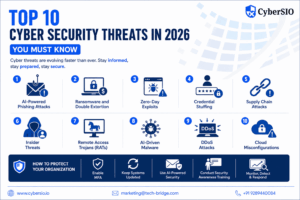
The top 10 cyber security threats are the most dangerous attack methods used by cybercriminals to steal data, disrupt operations, and compromise business systems. These threats include phishing, ransomware, zero-day exploits, credential theft, supply chain attacks, insider threats, remote access trojans, AI-powered malware, DDoS attacks, and cloud security misconfigurations.
1. AI-Powered Phishing Attacks
A phishing attack remains one of the most successful cyberattack techniques, but artificial intelligence has made it even more convincing. AI generates personalized emails, fake executive messages, and multilingual campaigns capable of bypassing traditional filters.
Common types of phishing attacks include spear phishing, business email compromise (BEC), vishing, and smishing. Sophos reported that 79% of ransomware incidents began with compromised identities, making phishing the leading attack vector.
Prevention
- Enable Multi-Factor Authentication (MFA)
- Conduct phishing awareness training
- Use AI-powered email security
- Implement threat intelligence solutions
Also read: PAM Solution: The Complete Guide to Privileged Access Management
2. Ransomware and Double Extortion
The ransomware meaning has evolved beyond file encryption. Modern cybercriminals first steal sensitive information before encrypting systems and demanding payment.
Microsoft’s Digital Defense Report 2025 found that 52% of observed nation-state and criminal attacks involved ransomware or extortion, while IBM’s Cost of a Data Breach Report 2025 estimated the average global breach cost at USD 4.44 million.
Well-known incidents like WannaCry ransomware demonstrate how quickly malicious malware can spread across unpatched systems.
Also read: Astra AI : Redefining the Modern SOC with Generative Intelligence
3. Zero-Day Exploits
A zero day exploit targets software vulnerabilities before vendors release security updates. Since organizations have little time to respond, these attacks frequently bypass traditional defenses.
According to Verizon’s 2026 Data Breach Investigations Report (DBIR), vulnerability exploitation became the number one breach entry point, accounting for 31% of incidents.
Organizations should reduce risk through rapid patch management, continuous vulnerability scanning, and frameworks such as MITRE ATT&CK.
4. Credential Stuffing
Credential stuffing uses stolen usernames and passwords from previous breaches to gain unauthorized access to business applications. Because many users reuse passwords across multiple platforms, attackers can automate login attempts at scale.
Identity-based attacks continue to grow as organizations expand cloud applications and remote work environments. Strong password policies, password managers, MFA, and continuous authentication significantly reduce this risk.
5. Supply Chain Attacks
Modern businesses depend on third-party software, cloud providers, and service vendors. This makes supply chain attacks one of the fastest-growing types of cyber threats.
ENISA’s Threat Landscape analyzed 4,875 cybersecurity incidents between July 2024 and June 2025, highlighting increasing compromises through trusted vendors and software updates.
Vendor risk assessments, software bill of materials (SBOM), and continuous monitoring are essential to reduce supply chain exposure.
6. Insider Threats
An insider threat doesn’t always involve a malicious employee. It can result from negligence, compromised accounts, or excessive privileges that lead to data leakage. According to the World Economic Forum’s Global Cybersecurity Outlook 2026, identity and human-related risks remain among the biggest cybersecurity challenges for organizations.
Prevention
- Enforce least-privilege access
- Monitor privileged accounts with UEBA
- Conduct regular security awareness training
Also read: Disinformation Security and Deepfake Detection
7. Remote Access Trojans (RATs)
A Remote Access Trojan (RAT) gives attackers complete control over an infected device, allowing them to steal credentials, deploy additional malware, and move laterally across networks. RATs are commonly delivered through phishing emails, malicious downloads, or exploited vulnerabilities.
Prevention
- Deploy Endpoint Detection and Response (EDR)
- Block suspicious downloads
- Keep operating systems and applications updated
8. AI-Driven Malware
Traditional antivirus solutions struggle against AI-generated malware attacks because attackers continuously modify code to evade detection. Modern types of malware now use automation to identify vulnerabilities, spread rapidly, and avoid signature-based security controls.
Organizations should combine AI-powered threat detection, behavioral analytics, and continuous threat hunting to identify malicious malware before it causes damage.
9. DDoS Attacks
A DoS and DDoS attack floods applications or networks with massive traffic, making critical services unavailable. These attacks are increasingly combined with ransomware campaigns to pressure organizations into paying extortion demands.
Cloud-based DDoS protection, redundant infrastructure, and traffic filtering significantly reduce business disruption.
10. Cloud Misconfigurations
As organizations accelerate cloud adoption, unsecured storage buckets, weak identity controls, and excessive permissions continue to expose sensitive data. Many successful breaches occur because of configuration errors rather than sophisticated hacking techniques.
Implementing Zero Trust principles, continuous cloud security posture management (CSPM), and regular security audits can help eliminate these risks.
Also read: Predictive Analysis in AIOps
Top 10 Cyber Security Threats at a Glance
| Threat | Business Impact | Recommended Defense |
| AI-Powered Phishing | Credential theft | MFA & awareness training |
| Ransomware | Business disruption | Offline backups & EDR |
| Zero-Day Exploits | System compromise | Rapid patch management |
| Credential Stuffing | Account takeover | Strong passwords & MFA |
| Supply Chain Attacks | Third-party breaches | Vendor risk management |
| Insider Threats | Data leakage | Least-privilege access |
| Remote Access Trojans | Remote system control | EDR & endpoint security |
| AI-Driven Malware | Evasive attacks | AI-powered detection |
| DDoS Attacks | Service downtime | DDoS protection |
| Cloud Misconfigurations | Data exposure | CSPM & Zero Trust |
How to Protect Your Organization
Cyber security is no longer about deploying a single firewall or antivirus solution. Organizations need a layered security strategy that combines technology, people, and processes.
Best practices include:
- Enable Multi-Factor Authentication (MFA)
- Patch vulnerabilities immediately
- Conduct regular vulnerability assessments
- Use AI-powered threat intelligence
- Monitor user behavior with UEBA
- Maintain offline backups for ransomware recovery
- Train employees to recognize phishing and social engineering attacks
- Partner with trusted cyber security companies that provide proactive cyber security services
Also read: From Alerts to Answers: How AI-Powered Root Cause Analysis is Reducing MTTR by 80%
Why CyberSIO Is Built to Combat Modern Cyber Security Threats
Defending against today’s top 10 cyber security threats requires more than standalone security tools, it demands a unified security platform. CyberSIO helps organizations detect, investigate, and respond to evolving cyber threats through AI-driven threat detection, centralized security monitoring, and automated incident response.
With NextGen tbSIEM, tbUEBA, tbSOAR, tbNDR, tbPatchManager, tbPAM, and tbNAC, CyberSIO delivers end-to-end protection against phishing attacks, ransomware, zero-day exploits, credential stuffing, insider threats, Remote Access Trojans (RATs), supply chain attacks, cloud threats, and advanced malware. Its AI/ML-powered anomaly detection, MITRE ATT&CK mapping, integrated threat intelligence, automated vulnerability remediation, behavioral analytics, privileged access management, and dynamic network access control help security teams identify risks early and respond faster.
Whether deployed on-premises, in the cloud, or in hybrid environments, CyberSIO provides organizations with the visibility, automation, and proactive defense needed to stay ahead of modern cybercrime while strengthening their overall cyber security posture.

Must Read Articles:
Understanding Identity Threat Detection and Response (ITDR)
What Is Network Access Control (NAC)?
Patch Management: Benefits, Challenges, and Best Practices for Modern IT Environments
SOC as a Service vs In-House SOC
IAM: A Complete Guide to Identity and Access Management
Frequently Asked Questions on Top AI Threats
1. What are the top cyber security threats in 2026?
The top cyber security threats include AI-powered phishing, ransomware, zero-day exploits, credential stuffing, and cloud misconfigurations.
2. Why are AI-powered phishing attacks so dangerous?
AI-powered phishing creates highly personalized and convincing scams that significantly increase the risk of credential theft.
3. How can businesses protect themselves from cyber security threats?
Businesses can reduce cyber risks by using MFA, timely patching, employee awareness training, and continuous security monitoring.
4. What is a zero-day exploit?
A zero-day exploit targets an unknown software vulnerability before a security patch or fix is available.
5. How does AI impact modern cyber security threats?
AI enables cybercriminals to launch faster, smarter, and more evasive attacks that are harder to detect.
6. How do ransomware attacks affect businesses?
Ransomware can disrupt operations, encrypt critical data, cause financial losses, and create significant recovery challenges.
7. What is a supply chain attack in cybersecurity?
A supply chain attack targets trusted vendors, software, or third-party services to gain access to an organization’s systems.
8. Why are cloud security risks increasing?
The growing use of cloud services expands the attack surface, making weak configurations, exposed credentials, and unsecured workloads potential entry points.
Sources:
Check Point Research: Cyber Security Report 2026
CrowdStrike 2026 Global Threat Report
Microsoft Digital Defense Report 2025
IBM Cost of a Data Breach Report 2025
Verizon 2026 Data Breach Investigations Report (DBIR)
ENISA Threat Landscape 2025
World Economic Forum – Global Cybersecurity Outlook 2026