A single compromised account can give attackers access to sensitive business data, critical systems, and enterprise networks. Without continuous monitoring, suspicious activity may remain unnoticed until significant damage occurs.
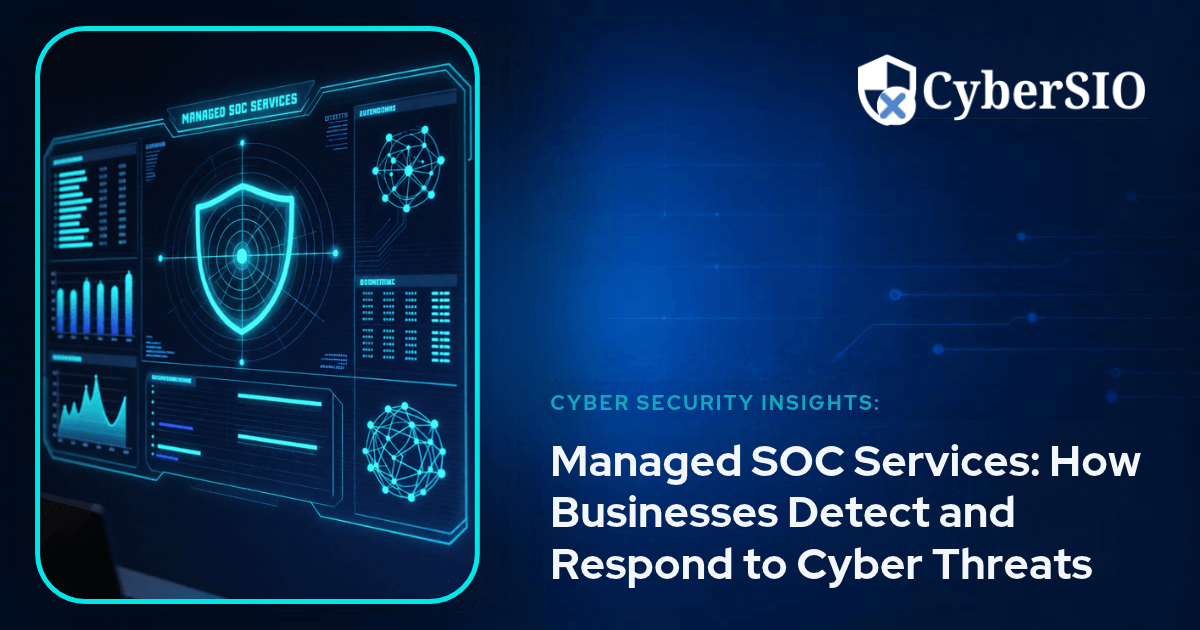
Managed SOC services help organizations monitor security events, investigate potential threats, and coordinate incident response without having to build every security capability internally. These services combine security technologies, experienced analysts, and defined response processes to improve visibility across IT environments.
According to IBM’s 2026 Cost of a Data Breach Report, the average cost of a data breach in India reached ₹25.5 crore, an increase of 15.9% from 2025. This growing financial impact highlights why organizations need effective security monitoring and incident management.
Understanding how managed SOC services work, what they include, and how to evaluate providers can help businesses make better cybersecurity decisions.
See how CyberSIO helps strengthen your security posture: Schedule a Free Demo.
What Are Managed SOC Services?
Managed SOC services involve outsourcing some or all security operations to a specialized provider that monitors systems, investigates alerts, and supports threat response.
A managed security operations center collects and analyzes security data from endpoints, servers, firewalls, cloud platforms, applications, and identity systems. Security analysts use this information to identify suspicious patterns and determine whether an event requires investigation.
Typical capabilities include:
- 24/7 security monitoring: Monitor security events across business systems.
- Threat detection: Identify malware, ransomware, suspicious logins, and unauthorized access.
- Threat hunting: Search for hidden threats that automated alerts may not detect.
- Incident investigation: Correlate events to understand the nature and potential impact of an attack.
- Incident response: Coordinate containment, remediation, and recovery activities.
- Security reporting: Provide incident records, risk insights, and operational reports.
The exact scope depends on the provider’s service agreement. Some providers deliver monitoring and alerting, while others offer broader investigation and response capabilities.
Also read: Patch Management Software: The Complete Enterprise Guide for 2026
How Do Managed SOC Services Work?
A typical managed SOC workflow follows five stages:
- Data collection: Security tools collect logs and telemetry from endpoints, networks, applications, cloud services, and identity systems.
- Event correlation: SIEM technology analyzes events from different sources to identify patterns that may indicate an attack.
- Threat investigation: Analysts examine alerts, enrich them with threat intelligence, and assess their severity and business impact.
- Response and containment: Depending on agreed permissions, the SOC team may isolate affected devices, disable compromised accounts, or coordinate remediation.
- Reporting and improvement: The team documents incidents, reviews detection gaps, and refines security rules and response playbooks.
For example, repeated failed logins followed by an unusual successful login could indicate credential compromise. By correlating identity and endpoint activity, analysts can investigate the incident and initiate appropriate response procedures.
Also read: What is SIEM?
Why Are Businesses Investing in Managed SOC Services?
IBM’s 2026 Cost of a Data Breach Report found that phishing was the most common initial attack vector in India, accounting for 19% of malicious breaches. The report also found that 26% of malicious breaches in India were AI-generated.
These findings highlight the need for security operations that can identify suspicious behavior and investigate emerging threats.
Managed SOC services can help organizations address several challenges:
- Limited in-house expertise: Gain access to specialized security skills without recruiting every role internally.
- Alert fatigue: Prioritize significant security events and reduce time spent on low-value alerts.
- Complex IT environments: Improve visibility across cloud, on-premises, remote, and hybrid infrastructure.
- Slow incident response: Establish investigation and escalation workflows before an incident occurs.
- Resource constraints: Supplement internal teams without independently building a complete SOC.
However, outsourcing does not eliminate security responsibilities. Organizations still need clear governance, appropriate access controls, and defined ownership of remediation decisions.
Source: IBM’s 2026 Cost of a Data Breach Report—India findings.
Also read: Top 10 Cyber Security Threats in 2026 You Must Know
Fully Managed SOC vs. Co-Managed SOC
Businesses can choose between different service models depending on their internal resources and desired level of control.
| Factor | Fully Managed SOC | Co-Managed SOC |
| Responsibilities | Provider handles most agreed SOC activities | Provider and internal team share responsibilities |
| Internal expertise | Smaller in-house SOC team may be sufficient | Existing security team remains actively involved |
| Operational control | Primarily provider-led within agreed scope | Shared control and decision-making |
| Best suited for | Organizations needing extensive external support | Organizations supplementing an existing SOC |
A fully managed SOC may suit businesses without the resources to operate security monitoring independently. A co-managed SOC can help established teams extend coverage, access specialist expertise, or improve incident response.
Before selecting either model, clarify monitoring hours, escalation procedures, response authority, service-level agreements, and responsibilities during major incidents.
How to Choose the Right Managed SOC Provider
When comparing managed SOC providers, look beyond advertised monitoring capabilities. Evaluate how effectively the service fits your environment and operational requirements.
Technology integration: Confirm compatibility with your existing SIEM, EDR, identity management, cloud, and network security tools.
Detection and investigation: Ask how the provider correlates alerts, investigates suspicious activity, and prioritizes threats according to business risk.
Incident response: Establish which actions the provider can perform independently and which require your approval.
Reporting and compliance: Review available dashboards, incident reports, audit trails, and support for relevant compliance requirements.
Scalability: Ensure the service can accommodate additional users, locations, cloud workloads, and business systems.
Measurable performance: Agree on meaningful metrics, including time to acknowledge alerts, time to investigate, response times, and incident escalation performance.
These criteria help organizations distinguish between basic monitoring services and broader managed security operations.
Also read: How to Choose the Right Cyber Security Company: 12 Key Factors to Consider
CyberSIO as a Managed SOC Technology Provider
Organizations evaluating managed SOC solutions can also consider platforms that bring threat detection, identity security, and risk management into a unified environment.
CyberSIO, developed by TechBridge Consultancy Services, is a SOC-in-a-Box platform designed to consolidate security visibility and support coordinated security operations.
Its capabilities include:
- tbSIEM: Centralizes security logs and correlates events to help identify potential threats.
- tbSOAR: Supports security workflow orchestration and automated response playbooks.
- tbUEBA: Analyzes user and entity behavior to help identify anomalies.
- tbPatchManager: Supports vulnerability and patch management activities.
These capabilities can help security teams connect threat monitoring with identity controls and risk reduction.
Organizations considering CyberSIO should assess its integration requirements, deployment model, operational workflows, and support arrangements against their specific needs. They should also confirm whether the proposed engagement includes a managed SOC service, a technology platform, or a combination of both.
Explore the CyberSIO platform to learn more about its security operations capabilities.
Must Read Articles:
- What Is ZTNA? A Complete Guide to Zero Trust Network Access
- Modern SOC for Indian Enterprises: DPDP Act, CERT-In Reporting & What to Log
- Agentic AI in Cyber Security: The Future of Autonomous Defense
- Network Security in 2026: Threats, Tools & Best Practices
- Network Detection and Response: How NDR Works, Benefits & Best Practices
- What Is SOAR? Security Orchestration, Automation and Response Explained