Today’s enterprise networks are more connected, and more vulnerable, than ever before. With employees working remotely, the rapid adoption of cloud services, the explosion of IoT devices, and the widespread use of BYOD (Bring Your Own Device) policies, organizations are struggling to maintain visibility and control over who and what connects to their networks.
According to Verizon’s Data Breach Investigations Report (DBIR), compromised credentials and unauthorized access continue to be among the leading causes of enterprise data breaches. Meanwhile, IBM reports that the global average cost of a data breach has surpassed USD 4.8 million, making proactive access control a business priority.
This is where Network Access Control (NAC) plays a crucial role. A modern network access control solution authenticates users, validates device health, and enforces security policies before granting access to enterprise resources. In this guide, you’ll learn how Network Access Control (NAC) works, its key benefits, best practices, and why it’s a cornerstone of every Zero Trust security strategy.
See how CyberSIO helps strengthen your security posture: Schedule a Free Demo.
What is Network Access Control (NAC)?
Network Access Control (NAC) is a cybersecurity framework that ensures only authorized users and compliant devices can access an organization’s network. Before allowing any connection, a network access control NAC solution verifies user identity, evaluates device posture, and applies predefined security policies.
Unlike a traditional network access control list, modern NAC platforms continuously monitor devices throughout their network session, ensuring ongoing compliance rather than relying on a one, time authentication process.
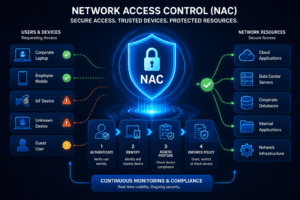
A typical NAC network solution performs four critical functions:
- User Authentication
- Device Identification
- Policy Enforcement
- Continuous Monitoring
Together, these capabilities strengthen access control in network security and reduce the organization’s attack surface.
Also read: PAM Solution: The Complete Guide to Privileged Access Management
Why Network Access Control Matters More Than Ever
Enterprise environments have evolved dramatically over the past decade.
Today’s organizations typically manage:
- Thousands of employee endpoints
- Remote workers accessing corporate applications
- Third, party vendors
- Cloud workloads
- Industrial IoT devices
- Smart office infrastructure
Industry research highlights the growing need for stronger network access control solutions:
| Industry Metric | Value |
| Organizations using hybrid work | 80%+ |
| Connected enterprise IoT devices by 2030 | 29+ billion |
| Average cost of a data breach | USD 4.8 Million |
| Organizations adopting Zero Trust by 2027 | Over 70% |
| Security breaches involving compromised endpoints | Approximately 70% |
Without effective NAC access control, organizations face several challenges:
- Unauthorized devices connecting to the network
- Limited visibility into connected assets
- Insider threats
- Non, compliant endpoints
- Increased ransomware exposure
- Difficulty meeting compliance standards
A network admission control solution addresses these challenges by ensuring every connection is authenticated, authorized, and continuously monitored.
How Network Access Control Works
Modern Network Access Control follows a structured process that aligns with Zero Trust principles.
1. User Authentication
Every user requesting access must first verify their identity using secure authentication methods such as:
- Active Directory
- LDAP
- Multi, Factor Authentication (MFA)
- RADIUS
- Digital Certificates
- Single Sign, On (SSO)
This ensures only verified identities can enter the enterprise network.
2. Device Identification
Once the user is authenticated, the network access control NAC platform identifies the connecting device.
It gathers information such as:
- Operating System
- Device Type
- MAC Address
- Installed Security Software
- Patch Status
- Antivirus Status
- Device Ownership
This creates complete visibility across the network.
3. Posture Assessment
Before granting access, the NAC solution evaluates whether the device complies with organizational security policies.
Typical checks include:
- Operating system updates
- Endpoint protection status
- Disk encryption
- Firewall configuration
- Critical security patches
- Malware detection
Devices failing compliance checks can be automatically isolated until remediation is complete.
4. Policy Enforcement
Once authentication and posture validation are complete, network access control applies dynamic policies based on:
- User role
- Department
- Device type
- Geographic location
- Time of access
- Risk score
This ensures employees only receive access to the resources required for their job responsibilities while reducing the risk of unauthorized lateral movement within the network.
Also read: Astra AI : Redefining the Modern SOC with Generative Intelligence
Core Features of Modern Network Access Control Solutions
A modern Network Access Control (NAC) solution goes far beyond basic authentication. It provides intelligent visibility, automated policy enforcement, and continuous compliance monitoring across the enterprise network.
1. Identity,Based Authentication
Modern NAC platforms support multiple authentication methods, including:
- Active Directory and LDAP integration
- RADIUS authentication
- Multi, Factor Authentication (MFA)
- Certificate, based authentication
- MAC, based authentication
- Guest and captive portal authentication
This ensures that only verified users and trusted devices gain network access.
2. Complete Device Visibility
One of the biggest security challenges for enterprises is knowing exactly what is connected to the network.
A NAC solution automatically discovers and profiles:
- Corporate laptops
- Personal devices (BYOD)
- Servers
- IP Phones
- Printers
- Cameras
- IoT devices
- OT devices
Real, time visibility enables IT teams to quickly identify unknown, unauthorized, or vulnerable devices before they become security risks.
3. Dynamic Policy Enforcement
Unlike static access rules, modern network access control solutions dynamically adjust permissions based on contextual factors such as:
- User role
- Device posture
- Department
- Network location
- Time of access
- Security risk level
This adaptive approach aligns perfectly with Zero Trust principles.
4. Automated Quarantine and Remediation
When a device becomes non, compliant, for example, due to outdated antivirus software or missing security patches, the NAC platform can automatically:
- Isolate the endpoint
- Restrict network access
- Redirect the user to a remediation portal
- Restore access once compliance is achieved
Automation significantly reduces manual intervention and accelerates incident response.
5. Network Segmentation
Network segmentation minimizes the impact of cyberattacks by limiting lateral movement.
Using network admission control, organizations can automatically place users and devices into dedicated VLANs or security zones based on business policies, improving both security and operational efficiency.
Also read: Disinformation Security and Deepfake Detection
Business Benefits of Network Access Control
Implementing a Network Access Control (NAC) solution delivers measurable improvements across security, compliance, and operational efficiency.
Improved Network Visibility
IT teams gain complete visibility into every connected user and endpoint, reducing shadow IT and unmanaged device risks.
Reduced Cyber Risk
Organizations can significantly lower their attack surface by blocking unauthorized users and continuously validating device compliance.
Better Compliance
NAC helps organizations meet regulatory requirements, including:
- ISO 27001
- PCI DSS
- HIPAA
- NIST Cybersecurity Framework
- GDPR
By enforcing standardized access policies and maintaining detailed audit logs, compliance reporting becomes simpler and more accurate.
Enhanced Secure Remote Access
With hybrid work becoming the norm, secure remote access is essential. NAC ensures remote employees are subject to the same authentication, posture assessment, and access policies as on, site users, maintaining a consistent security posture across all environments.
Operational Efficiency
Automating authentication, onboarding, and policy enforcement reduces the burden on IT teams. Industry studies indicate that organizations implementing automated network access management can reduce manual provisioning efforts by 40, 60%, enabling IT staff to focus on higher, value security initiatives.
Also read: Predictive Analysis in AIOps
Network Access Control vs Traditional Firewalls
| Feature | Traditional Firewall | Network Access Control |
| User Authentication | Limited | ✔ |
| Device Health Validation | ✖ | ✔ |
| Continuous Monitoring | ✖ | ✔ |
| BYOD Security | Limited | ✔ |
| IoT Visibility | Limited | ✔ |
| Dynamic Policy Enforcement | Partial | ✔ |
| Zero Trust Support | Partial | ✔ |
A firewall controls traffic entering and leaving the network, while NAC determines who and what is allowed to connect in the first place. Together, they provide a stronger defense against modern cyber threats.
Best Practices for Implementing Network Access Control
To maximize the effectiveness of your NAC deployment:
- Discover and inventory every connected device.
- Classify users and endpoints based on business roles.
- Implement Role, Based Access Control (RBAC).
- Enable continuous posture assessment.
- Integrate NAC with SIEM, IAM, EDR, and SOAR platforms.
- Segment critical assets using VLANs or micro, segmentation.
- Review and update security policies regularly.
- Monitor and audit network access continuously.
Following these best practices strengthens access control in cyber security while reducing operational complexity.
The Future of Network Access Control
The future of NAC is closely aligned with Zero Trust, AI, driven security, and cloud, native networking.
Emerging trends include:
- AI, powered device classification
- Continuous risk, based authentication
- Behavioral analytics
- Cloud, delivered NAC
- Integration with SASE and XDR
- Identity, centric security policies
- Automated incident response
As organizations continue adopting hybrid work, IoT, and multi, cloud environments, network NAC solutions will become a foundational component of enterprise cybersecurity strategies.
Also read: From Alerts to Answers: How AI-Powered Root Cause Analysis is Reducing MTTR by 80%
Why Choose CyberSIO tbNAC?
As organizations embrace hybrid work, cloud adoption, and Zero Trust, securing network access has never been more critical. CyberSIO tbNAC is an intelligent Network Access Control (NAC) solution that enables organizations to authenticate users, validate device health, and enforce granular access policies based on identity, device, location, and risk.
With features like real, time device visibility, agent, based and agentless posture assessment, automated quarantine, network segmentation, and seamless integration with Active Directory, SIEM, EDR, and RADIUS, tbNAC helps organizations prevent unauthorized access, simplify compliance, and strengthen their overall security posture. Whether you’re securing corporate offices, remote users, or IoT environments, tbNAC delivers the visibility, control, and automation needed to protect every network connection.

Must Read Articles:
Understanding Identity Threat Detection and Response (ITDR)
What Is Network Access Control (NAC)?
Patch Management: Benefits, Challenges, and Best Practices for Modern IT Environments
SOC as a Service vs In-House SOC
IAM: A Complete Guide to Identity and Access Management
Frequently Asked Questions on Network Access Control
What is Network Access Control (NAC)?
How does NAC improve cybersecurity?
What is the difference between NAC and a firewall?
What are Network Access Control solutions?
How does Network Access Control software work?
What are the benefits of Network Access Control?
Can NAC support BYOD and IoT devices?
How do you choose the right Network Access Control software?
Can Network Access Control integrate with other security tools?
How does NAC handle unauthorized devices?