Cybersecurity is no longer simply about deploying more security tools. IBM reported that the global average cost of a data breach reached $4.44 million in 2025, while the average cost in India was approximately $2.51 million.
Meanwhile, Gartner projected worldwide information-security spending to reach $213 billion in 2025, including approximately $83.8 billion on security services.
With organizations investing heavily in security, selecting among cyber security companies requires more than comparing prices or product lists. Businesses need to evaluate expertise, technology, response capabilities, scalability, compliance, integrations, and measurable value.
See how CyberSIO helps strengthen your security posture: Schedule a Free Demo.
12 Factors to Evaluate Cyber Security Companies
1. Security Expertise and Track Record
Look beyond the number of years a provider has been operating. Evaluate technical expertise, certifications, industry experience, customer references, and relevant security outcomes.
Ask whether the provider has experience with organizations facing challenges similar to yours.
2. Security Services and Coverage
A provider should match your security requirements instead of simply offering the largest service portfolio.
Depending on your environment, evaluate:
- SIEM and security monitoring
- SOAR and incident response
- UEBA
- IAM and PAM
- NAC
- Vulnerability management
- Patch management
- Endpoint and network security
- Identity threat detection
This helps distinguish genuine cyber security solution providers from vendors offering disconnected point solutions.
3. Independent Rankings and Recognition
Don’t select a provider simply because it appears in a top 10 cyber security companies article.
Consider independent evaluations and recognition from organizations such as Gartner, Forrester, IDC, and G2 where applicable.
Rankings can provide useful context, but they should never replace technical evaluation, customer references, and proof of capability.
4. Technology and Integration
Modern security environments contain multiple technologies. Your provider should be able to work with your existing infrastructure.
Evaluate integrations with:
- SIEM and SOAR
- EDR/XDR
- IAM and PAM
- NAC
- Firewalls
- Cloud platforms
- Threat intelligence
- ITSM systems
A connected security ecosystem can provide better visibility than isolated security tools.
Also read: Patch Management Software: The Complete Enterprise Guide for 2026
5. Threat Detection and Response
Ask a simple question:
What happens after a threat is detected?
Verizon’s 2025 Data Breach Investigations Report analyzed more than 22,000 security incidents and 12,195 confirmed breaches.
Evaluate detection, investigation, containment, escalation, response automation, and reporting—not just alert generation.
6. Compliance and Governance
Your provider should understand the regulations and security frameworks relevant to your organization.
The NIST Cybersecurity Framework 2.0 organizes cybersecurity around six functions: Govern, Identify, Protect, Detect, Respond, and Recover.
Check whether your shortlisted provider can support your audit, monitoring, governance, and security requirements.
7. Customer Evidence
Ask for relevant customer references and case studies.
Look for organizations with similar:
- Industry
- Infrastructure
- Business scale
- Compliance requirements
- Security challenges
Customer evidence is more valuable than generic claims about being one of the best cyber security companies.
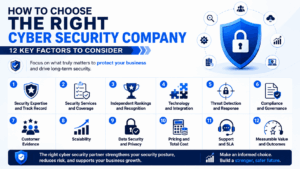
8. Scalability
Security requirements change as organizations grow.
Evaluate whether the provider can support additional users, endpoints, locations, applications, cloud workloads, and security events without creating additional tool silos.
9. Data Security and Privacy
If a provider handles your security data, understand how that data is protected.
Ask about:
- Encryption
- Access controls
- Data storage
- Data retention
- Audit logging
- Privacy practices
- Incident notification
This is particularly important when evaluating data security companies and cybersecurity consulting firms.
10. Pricing and Total Cost
Don’t compare providers solely on subscription price.
| Evaluation Area | What to Compare |
| Technology | Licensing, deployment and integrations |
| Services | Monitoring, response and professional services |
| Operations | Support, maintenance and upgrades |
| Scalability | Additional users, devices, locations or data |
| Contract | SLA, renewal, exit terms and additional charges |
A lower initial price may become expensive when essential services or integrations are excluded.
11. Support and SLA
Understand who responds when something goes wrong.
Review:
- Response-time commitments
- 24/7 availability
- Escalation procedures
- Reporting
- Technical support
- Incident communication
A reliable cyber security service provider should remain accountable after deployment.
12. Proof of Concept
Before making a long-term commitment, request a demonstration or proof of concept where practical.
Test whether the provider can:
- Detect relevant threats.
- Integrate with your environment.
- Provide meaningful security context.
- Demonstrate response workflows.
- Produce useful reporting.
A PoC can reveal capabilities that a sales presentation cannot.
Also read: Disinformation Security and Deepfake Detection
Why CyberSIO Can Be the Right Choice
When evaluating cyber security companies, organizations should look for a provider that reduces fragmentation rather than adding another isolated security layer.
CyberSIO is TechBridge’s SOC-in-a-Box platform, designed to unify Threat, Identity, and Risk Management through an AI-driven security fabric. Its platform brings together SIEM, SOAR, UEBA, IAM, PAM, NAC, Vulnerability & Patch Management, with these capabilities pre-integrated.
This directly addresses several of the evaluation criteria discussed above:
- Unified security: CyberSIO provides a single operational view across threat, identity, and risk rather than relying on disconnected tools.
- Automated response: CyberSIO’s SOAR capability uses predefined playbooks for detection, containment, remediation, alert enrichment, and cross-tool orchestration.
- Identity-aware detection: CyberSIO ITDR continuously analyzes identity behavior and can detect credential misuse, session replay, impossible travel, privilege escalation, lateral movement, and insider misuse.
- Broad integration: The provided CyberSIO material lists integrations across identity providers, SIEM, SOAR, PAM, NAC, EDR/XDR, threat-intelligence platforms, and AWS, Azure, and Google Cloud.
- Automated identity response: Its documented actions include adaptive MFA, session revocation, endpoint isolation, account disablement, privilege rollback, SOAR-triggered workflows, incident escalation, and SIEM enrichment.
- Regulated environments: CyberSIO states that it is designed for environments such as BFSI, government, and critical infrastructure, where compliance, auditability, and resilience are important.
CyberSIO also lists recognition including Gartner Emerging Tech Radar for ITDR & Disinformation Security in 2025 on its website.
Rather than choosing a cybersecurity provider simply because it is large or highly ranked, organizations can evaluate whether a platform such as CyberSIO aligns with their need for unified visibility, identity-aware detection, integrated security operations, and automated response.
Also read: Predictive Analysis in AIOps
Questions to Ask Before Choosing a Cyber Security Provider
Before selecting a cyber security services company, ask:
- What threats can you detect and respond to?
- Which technologies can you integrate?
- What happens after a critical alert?
- What response SLA do you provide?
- Can you demonstrate the platform?
- Can you provide relevant customer references?
- How is security data protected?
- What is included in the total cost?
- Can the solution scale with our environment?
Also read: What Is SOAR? Security Orchestration, Automation and Response Explained
How to Shortlist the Best Cyber Security Companies
Start with three to five providers and evaluate each against the same criteria.
Compare:
Expertise → Security Coverage → Technology → Detection & Response → Integration → Compliance → Scalability → Customer Evidence → Support → Total Cost
Don’t choose a provider simply because it appears when searching for cyber security companies near me, biggest cyber security companies, or best cyber security companies.
The best provider is the one that fits your organization’s security requirements and can demonstrate that capability.
Also read: PAM Solution: The Complete Guide to Privileged Access Management
Making the Right Cyber Security Investment
Choosing among cyber security companies should be a structured business and security decision—not a popularity contest.
Evaluate independent recognition, technical capabilities, integrations, response processes, customer evidence, compliance, scalability, support, and total cost.
Then validate the shortlist through demonstrations, references, and a proof of concept.
The right cybersecurity partner isn’t necessarily the biggest company. It is the provider that can give your organization the visibility, control, response capability, and security outcomes it actually needs.
Must Read Articles:
Understanding Identity Threat Detection and Response (ITDR)
What Is Network Access Control (NAC)?
Patch Management: Benefits, Challenges, and Best Practices for Modern IT Environments
SOC as a Service vs In-House SOC
IAM: A Complete Guide to Identity and Access Management
Frequently Asked Questions About Choosing a Cyber Security Company
What should I look for when choosing a cybersecurity company?
How do I compare different cyber security companies?
What cybersecurity services should a company provide?
Why are integrations important when choosing a cybersecurity provider?
How important are SLAs when selecting a cybersecurity service provider?
Should I consider a cybersecurity company's certifications and industry recognition?
What is a cybersecurity proof of concept (PoC)?
How can I evaluate the total cost of a cybersecurity solution?
Is CyberSIO suitable for organizations seeking an integrated cybersecurity platform?
How many cybersecurity companies should I shortlist before making a decision?
What factors determine the cost of cybersecurity services?
Sources:
IBM Cost of a Data Breach Report 2025
Verizon DBIR 2025
Gartner