A traditional network perimeter is no longer enough to protect modern organizations. Employees work remotely, applications run across multiple clouds, and attackers increasingly target identities rather than simply trying to break through a firewall.
This is where ZTNA (Zero Trust Network Access) becomes important. ZTNA changes how organizations provide access by verifying users, devices, applications, and context before granting access to specific resources. In this guide, you will learn what ZTNA is, how it works, how it fits into a zero trust architecture, and why organizations are moving toward this approach.
See how CyberSIO helps strengthen your security posture: Schedule a Free Demo.
What Is ZTNA?
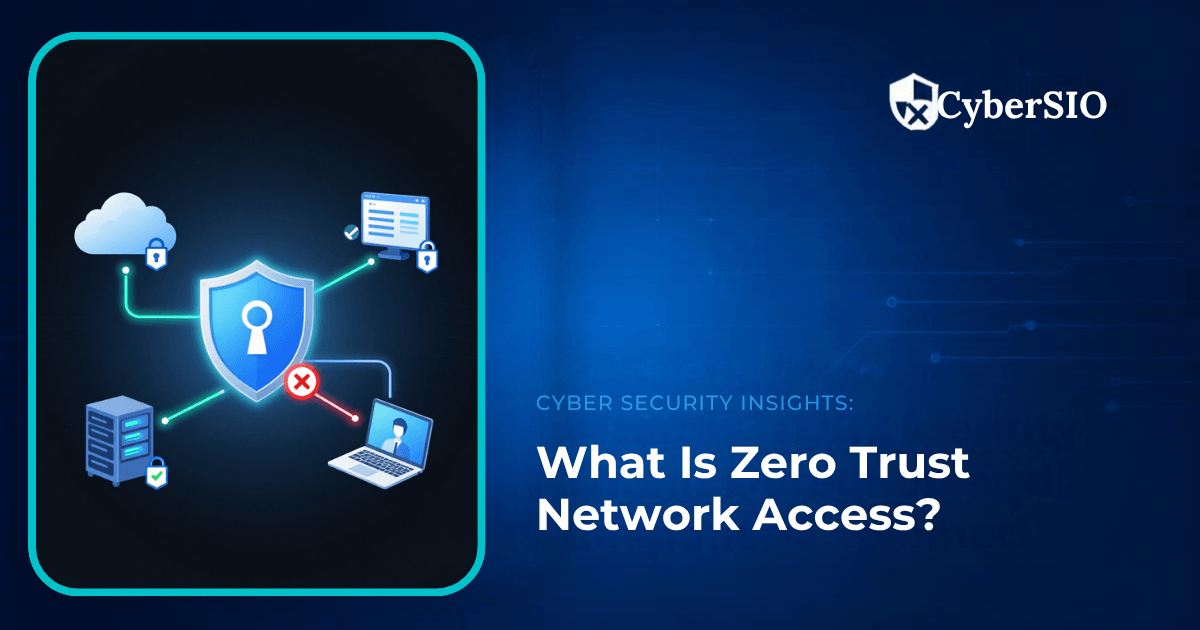
ZTNA is an access security approach that provides users with controlled access to specific applications and resources rather than giving them broad access to an entire network.
Unlike traditional remote-access models, ZTNA does not assume that a user or device should be trusted simply because it is connected to the corporate network.
This aligns closely with NIST’s definition of zero trust architecture, which removes implicit trust based on network location and focuses on protecting individual resources. NIST also emphasizes that authentication and authorization should occur before access to an enterprise resource is established.
In simple terms: ZTNA verifies first, grants limited access, and continuously evaluates whether that access should continue.
Also read: PAM Solution: The Complete Guide to Privileged Access Management
Why Does ZTNA Matter in Modern Security?
Enterprise networks have changed dramatically. Organizations now support remote employees, contractors, BYOD, SaaS applications, hybrid infrastructure, and multi-cloud environments.
A perimeter-based security strategy can struggle in this environment because the network itself no longer represents a reliable trust boundary.
Identity security is also becoming increasingly important. According to Verizon’s 2025 research, compromised credentials were an initial access vector in 22% of the breaches reviewed in its 2025 DBIR research.
This demonstrates why simply protecting the network perimeter is not enough. Organizations need stronger controls around who is requesting access, what device they are using, what they are accessing, and whether the request is consistent with security policy.
Zero trust adoption is also gaining momentum. Okta reported that 61% of surveyed organizations had a defined Zero Trust initiative in 2023, compared with 24% in 2021.
Cloudflare research has also found that 80% of surveyed security leaders were committed to Zero Trust adoption, while only 39% had completed at least one Zero Trust pilot in the study.
These figures show an important trend: interest in Zero Trust is high, but organizations still need practical ways to implement it.
Also read: IAM: A Complete Guide to Identity and Access Management
How Does ZTNA Work?
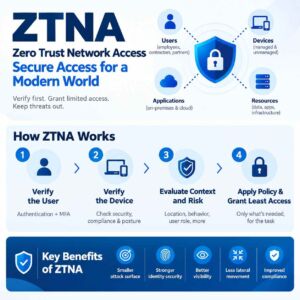
ZTNA applies zero trust principles to application and resource access. A typical ZTNA process involves several steps.
1. Verify the User
The system first determines who is requesting access.
Authentication can involve:
- Username and password
- MFA
- Passwordless authentication
- Single sign-on
- Identity-provider verification
2. Verify the Device
ZTNA can evaluate whether the requesting device meets the organization’s security requirements.
Factors may include:
- Device identity
- Operating system
- Security status
- Endpoint protection
- Patch status
- Device compliance
3. Evaluate Context and Risk
Access decisions can consider more than identity.
For example, the system may evaluate:
- User location
- Device posture
- Time of access
- Application requested
- User role
- Previous behavior
- Risk indicators
4. Apply Zero Trust Policy
The organization defines a zero trust policy that determines which users or devices can access particular resources.
For example:
| Access Request | Security Decision |
| Employee + compliant device + approved application | Allow |
| Employee + unmanaged device | Restrict or deny |
| Contractor + approved application | Allow limited access |
| Unknown device + sensitive application | Deny |
| High-risk login + privileged resource | Require additional verification |
This approach ensures that access decisions are based on policy and context rather than network location alone.
5. Provide Least-Privilege Access
ZTNA should provide only the access required for the user’s task.
For example, an employee who needs access to a CRM application should not automatically receive access to internal servers, databases, or other applications.
This supports one of the most important zero trust principles: least-privilege access.
ZTNA and Zero Trust Architecture
ZTNA and zero trust architecture are closely related, but they are not exactly the same.
Zero Trust is the broader security strategy and framework. It covers identity, devices, applications, data, networks, workloads, and security policies.
ZTNA is a specific access-control approach that applies Zero Trust principles to network and application access.
NIST describes Zero Trust as an architecture focused on protecting resources rather than relying on network segments as the primary security boundary.
Modern zero trust architecture can therefore include technologies such as:
- Identity and access management
- MFA
- Endpoint security
- ZTNA
- Security analytics
- Data protection
- Policy enforcement
- Continuous monitoring
For cloud-native environments, NIST also describes a shift toward identity-based controls for users, applications, and services across multi-cloud environments.
Key Zero Trust Principles Behind ZTNA
A strong zero trust security model generally follows several principles:
Never trust by default: Network location should not automatically establish trust.
Verify continuously: Authentication should not be treated as a one-time event.
Use least privilege: Give users only the access they need.
Assume breach: Security architecture should limit the damage if an account or device is compromised.
Enforce policy: Access decisions should be based on defined security policies and contextual information.
CISA’s Zero Trust Maturity Model provides organizations with a structured roadmap for developing Zero Trust capabilities across multiple security areas.
Also read: Predictive Analysis in AIOps
ZTNA vs VPN: What’s the Difference?
Traditional VPNs generally place authenticated users onto a network or network segment. ZTNA focuses more narrowly on providing access to authorized applications and resources.
ZTNA can therefore reduce unnecessary network exposure and limit lateral movement.
This is particularly useful for organizations with remote employees, contractors, cloud applications, and third-party users.
The objective is not simply to replace every VPN immediately. Instead, organizations can gradually identify applications and access scenarios where an identity-centric approach provides stronger control.
Benefits of ZTNA
A well-designed ZTNA implementation can provide several security and operational benefits:
- Reduced attack surface: Users do not automatically receive broad network access.
- Least-privilege access: Access can be restricted to required applications.
- Better visibility: Security teams can gain greater insight into access activity.
- Improved remote access: Employees can securely access applications from different locations.
- Stronger identity security: Access decisions can incorporate authentication and identity context.
- Reduced lateral movement: Compromised users may have less ability to move across the environment.
- Cloud readiness: ZTNA can support resources distributed across on-premises and cloud environments.
NIST’s implementation guidance highlights Zero Trust architectures designed to support hybrid workforces and resources distributed across on-premises and multiple cloud environments.
Also read: Top 10 Cyber Security Threats in 2026 You Must Know
What Should You Consider When Choosing ZTNA Solutions?
Organizations evaluating ZTNA solutions should look beyond basic remote-access functionality.
Important considerations include:
- Identity integration: Does it integrate with existing IAM and identity providers?
- Device posture: Can it evaluate device security before access?
- Policy control: Can administrators create granular access policies?
- Application visibility: Can access be restricted at the application level?
- MFA support: Does it integrate with strong authentication?
- Cloud compatibility: Can it protect hybrid and multi-cloud environments?
- Monitoring: Can security teams investigate access activity?
- Scalability: Can it support users, applications, contractors, and remote locations as the organization grows?
The best ZTNA solutions are therefore not simply the ones that provide remote connectivity. They should support the broader goal of implementing a measurable and policy-driven zero trust security strategy.
Also read: Agentic AI in Cyber Security: The Future of Autonomous Defense
The Future of ZTNA and Zero Trust Security
As organizations move toward cloud-first environments, hybrid work, and increasingly distributed infrastructure, traditional network-based trust is becoming harder to maintain. ZTNA provides a practical way to apply Zero Trust principles by verifying users and devices, enforcing least-privilege access, and continuously evaluating risk.
However, ZTNA should not be viewed as a standalone security product. It works best as part of a broader zero trust architecture that combines identity, endpoint security, access policies, monitoring, and continuous verification.
For organizations beginning their Zero Trust journey, a practical approach is to identify critical applications, strengthen identity controls, assess device posture, and gradually introduce granular access policies. This allows security teams to reduce unnecessary exposure while building a more adaptive and resilient security model.

Must Read Articles:
- Understanding Identity Threat Detection and Response (ITDR)
- Patch Management: Benefits, Challenges, and Best Practices for Modern IT Environments
- SOC as a Service vs In-House SOC
- Astra AI : Redefining the Modern SOC with Generative Intelligence
- Disinformation Security and Deepfake Detection
Frequently Asked Questions on ZTNA
1. What is ZTNA?
2. How does ZTNA work?
3. What are the benefits of ZTNA?
4. What is the difference between ZTNA and VPN?
5. Is ZTNA part of Zero Trust architecture?