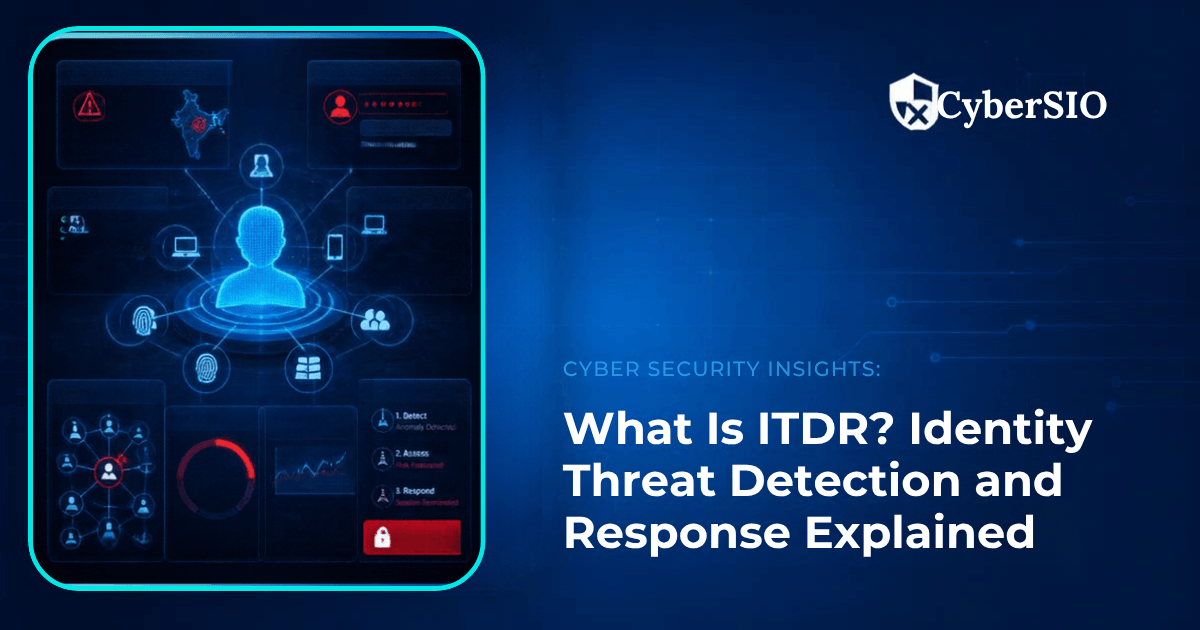
Identity is now one of the most important attack surfaces in modern enterprises. Stolen credentials, privilege abuse, session hijacking, insider misuse, and account takeover can allow attackers to operate through legitimate identities rather than obvious malware.
ITDR (Identity Threat Detection and Response) addresses this problem by continuously monitoring identity activity, detecting suspicious behavior, and triggering appropriate responses. But what should an effective ITDR security strategy actually include?
See how CyberSIO helps strengthen your security posture: Schedule a Free Demo.
What Is ITDR?
ITDR is a cybersecurity approach focused on detecting, investigating, and responding to threats involving digital identities, accounts, privileges, and authentication sessions.
Unlike traditional identity management, which primarily controls who can access what, ITDR focuses on identifying when a legitimate identity may be compromised, misused, or behaving abnormally.
Why ITDR Matters
The 2026 Verizon DBIR reports that credential abuse accounted for 25% of breaches in APAC, while exploitation of vulnerabilities accounted for 42%.
In India, IBM’s 2025 research found that phishing remained the leading initial attack vector at 18%, while the average cost of a data breach reached ₹22 crore.
This makes continuous identity monitoring increasingly important.
Also read: Patch Management Software: The Complete Enterprise Guide for 2026
What Does ITDR Security Detect?
Effective ITDR security should look beyond failed login attempts and identify behavioral and contextual anomalies.
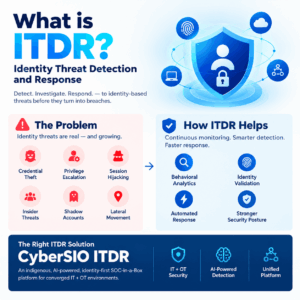
| Identity Threat | ITDR Detection Capability |
|---|---|
| Credential theft | Behavioral anomaly detection |
| Session hijacking | Session telemetry analytics |
| Privilege escalation | Real-time privilege monitoring |
| Insider threats | Behavioral deviation analysis |
| Shadow accounts | Identity lifecycle monitoring |
| Lateral movement | Identity-flow correlation |
| Account takeover | Context-aware authentication |
| Privileged misuse | PAM-integrated session analytics |
| Impossible travel | Geo-velocity intelligence |
| Impersonation | Multimodal identity validation |
These capabilities allow security teams to investigate how an identity is behaving, not simply whether authentication succeeded.
How Do ITDR Solutions Work?
Modern ITDR solutions combine identity telemetry with behavioral analytics and security controls.
1. AI-Driven Identity Behavior Analysis
An ITDR platform can establish behavioral baselines using signals such as:
- Login patterns
- Keystroke dynamics
- Mouse movement
- Browser fingerprints
- Session telemetry
- Access timing and location
- Resource usage
AI/ML models can continuously refine these baselines and identify deviations. CyberSIO ITDR, for example, uses UEBA-based anomaly detection, peer-group comparison, temporal analytics, risk scoring, and behavioral fusion.
2. Continuous Identity Validation
Identity security should not end after successful authentication.
ITDR can continuously evaluate whether the user’s behavior, session, privilege, device, and context remain trustworthy.
This helps identify session hijacking, credential misuse, impossible travel, off-hours access, privilege escalation, lateral movement, and insider misuse.
3. Automated Response
Detection becomes more valuable when it can lead directly to containment.
Depending on threat severity, CyberSIO ITDR supports actions including adaptive MFA, session revocation, endpoint isolation, account disablement, privilege rollback, SOAR-triggered workflows, incident escalation, and SIEM enrichment.
For example:
- Low: Audit logging and monitoring
- Medium: MFA challenge and SOC alert
- High: Session termination and account lock
- Critical: Privilege revocation and NAC isolation
Also read: Top 10 Cyber Security Threats in 2026 You Must Know
ITDR Identity Security Needs Broader Integration
Identity threats rarely exist in isolation. An effective ITDR architecture should connect identity intelligence with the wider security stack.
CyberSIO ITDR integrates with identity providers including Okta, Azure AD, Ping Identity, ForgeRock, LDAP/Active Directory, alongside SIEM, SOAR, PAM, NAC, EDR/XDR, threat intelligence platforms, and cloud environments such as AWS, Azure, and Google Cloud.
This creates a stronger security context for investigation and response.
Also read: Network Access Control (NAC): The Foundation of Modern Enterprise Security
CyberSIO: A Practical ITDR Approach
For organizations dealing with fragmented identity, endpoint, network, and security telemetry, the problem is not simply detecting suspicious logins. The larger challenge is connecting identity behavior, privilege, session activity, device context, and response into one security workflow.
CyberSIO is an indigenous, AI-powered, identity-first SOC-in-a-Box platform designed to secure the converged IT + OT environment of power utilities—from enterprise IT and data centres to generation plants, substations, SCADA environments, load-dispatch operations and remote sites.
Its ITDR capabilities bring together SIEM, UEBA, PAM, IAM, NAC, and SOAR to provide identity-centric threat intelligence, behavioral analytics, adaptive authentication, and automated response.
It also addresses specific identity risks such as credential compromise, privilege escalation, insider threats, session hijacking, shadow identities, and deepfake/impersonation attacks.
For organizations requiring privacy-conscious identity analytics, its architecture includes federated learning, local behavioral model training, PII-aware telemetry handling, encrypted identity analytics, secure token management, and RBAC.
The result is an approach that connects identity detection with the broader SOC instead of treating identity as a separate security silo.
Key Takeaway
ITDR is becoming an important layer of modern cybersecurity because compromised identities can bypass traditional perimeter-focused defenses. The strongest approach combines continuous identity validation, behavioral analytics, privilege monitoring, contextual detection, and automated response.
For hybrid and IT+OT environments, CyberSIO provides these capabilities within an identity-first SOC architecture, with integrations and governance features designed for enterprise and critical-infrastructure security.

Must Read Articles:
- What Is ZTNA? A Complete Guide to Zero Trust Network Access
- Modern SOC for Indian Enterprises: DPDP Act, CERT-In Reporting & What to Log
- Agentic AI in Cyber Security: The Future of Autonomous Defense
- Network Security in 2026: Threats, Tools & Best Practices
- Network Detection and Response: How NDR Works, Benefits & Best Practices
- How to Choose the Right Cyber Security Company: 12 Key Factors to Consider
- What Is SOAR? Security Orchestration, Automation and Response Explained
Frequently Asked Questions on ITDR
1. What is ITDR in cybersecurity?
2. Why is ITDR important for organizations?
3. How does ITDR security work?
4. What are ITDR solutions used for?
5. How does CyberSIO ITDR protect identities?