Cyber threats are becoming faster, more targeted and harder to investigate using isolated security tools. In 2026, 31% of breaches involved exploitation of software vulnerabilities, making vulnerability exploitation the leading breach entry point for the first time in Verizon DBIR history (Verizon: 2026 Data Breach Investigations Report).
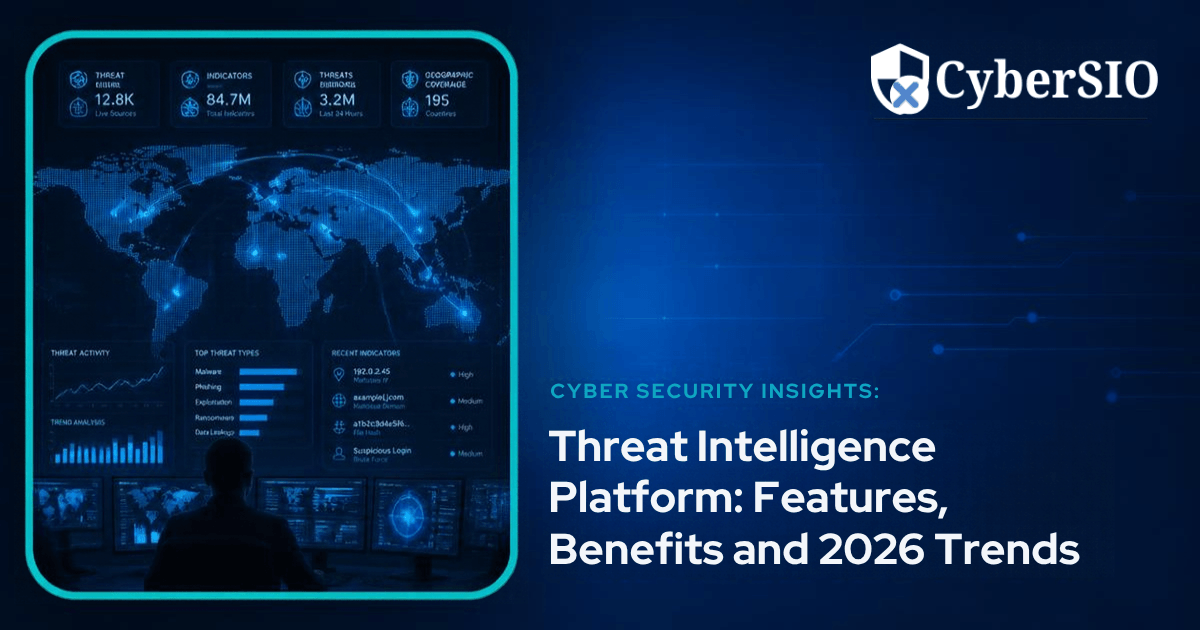
A threat intelligence platform helps security teams turn large volumes of threat data into actionable intelligence. Instead of simply collecting indicators, modern platforms connect threat actors, vulnerabilities, malware, infrastructure, tactics and organizational risk so teams can decide what requires attention first.
See how CyberSIO helps strengthen your security posture: Schedule a Free Demo.
What Is a Threat Intelligence Platform?
A threat intelligence platform is a security solution that collects, processes, analyzes and distributes information about cyber threats. It can combine data from threat feeds, security systems, open sources, dark web monitoring, vulnerability information and internal telemetry.
The objective is simple: turn raw threat data into intelligence that security teams can act on.
How Does Threat Intelligence Work?
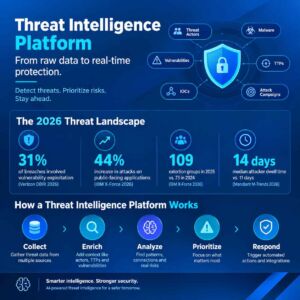
A modern threat intelligence lifecycle generally includes:
- Collection: Gather indicators, reports, vulnerabilities and threat data.
- Enrichment: Add context such as reputation, geography, threat actors and TTPs.
- Analysis: Identify relationships, patterns and potential attack paths.
- Prioritization: Determine which threats represent the greatest business risk.
- Action: Send intelligence to SIEM, SOAR, EDR, firewalls or other controls.
- Feedback: Use investigation results to continuously improve intelligence.
This approach allows security teams to move beyond simply asking “Is this indicator malicious?” and instead ask “Does this threat matter to our organization right now?”
Why Threat Intelligence Matters in 2026
The threat landscape is expanding rapidly. IBM X-Force reported a 44% year-over-year increase in attacks exploiting public-facing applications in its 2026 Threat Intelligence Index (IBM — X-Force Threat Intelligence Index 2026).
The same report identified 109 extortion groups active in 2025, compared with 73 in 2024 (IBM — X-Force Threat Intelligence Index 2026).
Meanwhile, Mandiant reported that global median attacker dwell time increased to 14 days, up from 11 days in the previous reporting period (Google Cloud/Mandiant — M-Trends 2026).
These numbers highlight an important challenge: organizations need intelligence early enough to identify emerging risks before they become incidents.
Key Features of a Threat Intelligence Platform
Not every threat intel platform provides the same level of intelligence or operational integration. Organizations should evaluate platforms based on how effectively they turn intelligence into security outcomes.
Threat Data Collection and Enrichment
A capable platform should collect intelligence from multiple sources and enrich indicators such as:
- IP addresses
- Domains and URLs
- File hashes
- Malware
- Vulnerabilities
- Threat actors
- Attack campaigns
- Tactics, techniques and procedures
Gartner identifies IoC enrichment, technical intelligence collection, risk scoring, interactive analysis and machine-to-machine integrations among the important capabilities for cyber threat intelligence technologies (Gartner — Cyberthreat Intelligence Technologies, 2026).
Threat Actor and TTP Analysis
Indicators alone rarely tell the complete story.
Security teams need to understand who is behind an attack, what techniques they use, what infrastructure they control and which assets may be exposed.
Mapping intelligence to frameworks such as MITRE ATT&CK can help analysts connect observed activity with known adversary techniques.
Also read: Top 10 Cyber Security Threats in 2026 You Must Know
Risk-Based Prioritization
A threat intelligence platform should help analysts distinguish between information that is interesting and information that is dangerous.
For example, an intelligence platform could prioritize a vulnerability when it is:
- Actively exploited
- Relevant to the organization’s technology stack
- Associated with known threat actors
- Linked to malicious infrastructure
- Connected to a critical business asset
This reduces the amount of manual investigation required from already-busy SOC teams.
Also read: Modern SOC for Indian Enterprises: DPDP Act, CERT-In Reporting & What to Log
Integrations and Automated Response
Threat intelligence becomes more valuable when it reaches the security controls that can act on it.
Modern platforms can integrate with SIEM, SOAR, EDR, firewalls, vulnerability management, identity platforms and other security technologies.
Standards and integrations such as APIs, STIX/TAXII and MISP can also support machine-readable intelligence exchange (Gartner — Cyberthreat Intelligence Technologies, 2026).
Types of Threat Intelligence Platforms
Threat intelligence platforms can be grouped according to the type of intelligence and operational use they support.
| Type | Primary Focus | Typical Use |
| Strategic intelligence | Business-level risks and trends | CISOs and security leadership |
| Tactical intelligence | Adversary TTPs | Threat hunting and defense planning |
| Operational intelligence | Campaigns and threat actors | SOC investigations |
| Technical intelligence | IOCs and technical indicators | Detection and blocking |
| Digital risk intelligence | External exposure | Brand, domain, dark web and third-party monitoring |
Organizations may use one platform for several intelligence types rather than operating separate tools for each requirement.
How to Choose the Best Threat Intelligence Platform
Searching for the best threat intelligence platform should not be based only on the size of its threat database.
Security teams should evaluate:
- Data quality: Are intelligence sources relevant and reliable?
- Context: Does the platform explain why a threat matters?
- Risk scoring: Can analysts prioritize threats effectively?
- Integrations: Can intelligence reach existing security controls?
- Automation: Can repetitive enrichment and response actions be automated?
- Visibility: Can teams connect external intelligence with internal activity?
- Scalability: Can the platform support growing data volumes?
- Deployment: Does it fit cloud, on-premises or hybrid requirements?
Well-known commercial platforms include solutions such as Recorded Future, while open source threat intelligence platforms such as MISP provide organizations with flexible intelligence collection, correlation and sharing capabilities.
Gartner’s 2026 Magic Quadrant for Cyberthreat Intelligence Technologies includes vendors such as Recorded Future, CrowdStrike, Google, Group-IB, KELA, SOCRadar and ZeroFox among the evaluated providers (Gartner — Magic Quadrant for Cyberthreat Intelligence Technologies, 2026).
The right choice ultimately depends on the organization’s intelligence requirements, existing security architecture and operational maturity.
Also read: How to Choose the Right Cyber Security Company
Threat Intelligence Platforms in 2026: What Is Changing?
Threat intelligence is moving from static feeds toward contextual, automated and AI-assisted intelligence.
Gartner notes that AI-based predictive threat intelligence is helping shift cybersecurity from reactive defense toward more proactive and preemptive approaches (Gartner — The Rise of AI-Based Predictive Threat Intelligence, 2025).
At the same time, Verizon reported that 15% of attack techniques in its 2026 DBIR were augmented by generative AI (Verizon — 2026 Data Breach Investigations Report).
This means intelligence platforms increasingly need to answer three questions:
What is happening?
Why does it matter?
What should security teams do next?
AI can help correlate large volumes of signals, identify anomalies, prioritize threats and accelerate investigation. However, AI is most useful when connected to reliable intelligence and existing security controls rather than operating as an isolated layer.
Also read: AI in Cybersecurity: 12 Emerging Trends Reshaping Security in 2026
From Threat Intelligence to Threat Action
The future of threat intelligence is not simply collecting more information. It is about connecting intelligence with detection, identity, risk and response.
This is where an AI-powered security architecture can provide a broader operational advantage. Platforms such as CyberSIO combine AI-driven threat detection, threat intelligence, behavioral analytics, SIEM and automated response within a unified SOC-in-a-Box approach.
Its architecture connects threat intelligence with security operations, helping teams correlate intelligence with logs, user behavior, identities and risk rather than treating threat intelligence as a standalone feed.
For enterprises dealing with fragmented security tools, the goal is increasingly clear: move from knowing about threats to understanding which threats matter—and acting on them faster.

Must Read Articles:
- What Is ZTNA? A Complete Guide to Zero Trust Network Access
- Agentic AI in Cyber Security: The Future of Autonomous Defense
- Network Security in 2026: Threats, Tools & Best Practices
- Network Detection and Response: How NDR Works, Benefits & Best Practices
Frequently Asked Questions on threat intelligence platform
1. What is a threat intelligence platform?
2. How does a threat intelligence platform work?
3. Why is threat intelligence important?
4. What features should a threat intelligence platform have?
5. What is an AI-powered threat intelligence platform?