Cybersecurity is entering an era where attacks can move at machine speed. AI is helping attackers discover vulnerabilities faster, automate malicious activity and create more convincing social engineering, while organizations continue to manage complex and fragmented security environments.
This is changing the future of cyber security. The next generation of protection will need more than traditional firewalls, endpoint security or isolated monitoring tools. Organizations will increasingly need AI-powered detection, identity-aware security, continuous risk management and automated response.
See how CyberSIO helps strengthen your security posture: Schedule a Free Demo.
What Is the Future of Cyber Security?
The future of cyber security is moving from reactive protection to continuous, intelligent defense.
According to the World Economic Forum’s 2026 Global Cybersecurity Outlook, 94% of respondents expect AI to be the most significant driver of cybersecurity change. The same report found that organizations assessing the security of AI tools increased from 37% in 2025 to 64% in 2026.
The threat landscape is changing just as quickly. Verizon’s 2026 DBIR found that 31% of breaches started with software vulnerabilities, while 48% involved ransomware and 15% of attack techniques were enhanced by generative AI.
These trends point toward a security model that is faster, more connected and more adaptive.
Also read: Patch Management Software: The Complete Enterprise Guide for 2026
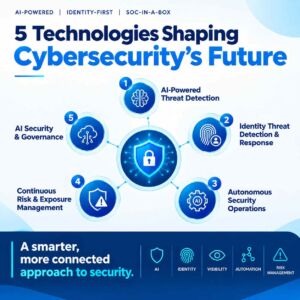
5 Technologies Shaping Cybersecurity’s Future
1. AI-Powered Threat Detection
Security teams already face enormous volumes of alerts, logs and behavioral data. AI can help identify patterns that traditional rule-based systems may miss.
Future security platforms will increasingly correlate identity, device, network, application and behavioral context to distinguish genuine threats from normal activity.
2. Identity Threat Detection and Response
Identity is becoming one of the most important security control points.
Stolen credentials and excessive privileges can allow attackers to appear legitimate. As a result, the future of information security will increasingly require continuous monitoring of identity behavior, privileges and access patterns.
This is where Identity Threat Detection and Response (ITDR) becomes important—helping organizations detect suspicious identity activity and respond before compromised accounts become larger security incidents.
3. Autonomous Security Operations
The future of computer security will involve greater use of AI-assisted investigation and automated response.
AI can help security teams:
- Prioritize high-risk incidents
- Correlate security signals
- Investigate suspicious behavior
- Recommend response actions
- Automate predefined containment workflows
IBM’s 2026 Cost of a Data Breach research found that one in four malicious breaches were AI-enabled, representing a 56% increase over the previous year. These breaches cost an average of $6 million.
4. Continuous Risk and Exposure Management
Security cannot stop at detecting an attack.
Future cybersecurity technologies will increasingly connect vulnerability management, asset visibility, threat intelligence and patching so organizations can identify weaknesses before attackers exploit them.
This is particularly important as vulnerability exploitation became the number-one breach entry point in Verizon’s 2026 DBIR.
5. AI Security and Governance
AI is becoming an attack surface itself.
Organizations must protect AI models, control access, monitor AI usage and govern autonomous systems. The World Economic Forum reported that 87% of respondents identified AI-related vulnerabilities as the fastest-growing cyber risk during 2025.
The future of data security will therefore involve protecting not only databases and applications, but also the AI systems and data they access.
Why Traditional Security Models Are Struggling
Many organizations manage security through separate products:
SIEM → IAM → PAM → NAC → Vulnerability Management → SOAR
Each technology can provide valuable protection, but disconnected systems can create visibility gaps.
Attackers do not necessarily stay inside one security domain. They can move between identities, endpoints, applications, networks, cloud environments and operational technology.
That means the future of network security cannot depend only on network boundaries. Security needs to understand who is accessing what, from where, with what privileges and whether that behavior is normal.
What the Future of Cyber Security Looks Like
The emerging model can be summarized as:
Detect → Understand → Predict → Respond → Learn
Organizations will increasingly need:
- Unified security visibility
- AI-assisted detection
- Identity-aware analytics
- Automated response
- Continuous exposure management
- AI governance
- IT + OT security visibility
The objective is not simply to deploy more security products. It is to connect security intelligence so teams can understand threats faster and respond with greater context.
Also read: What Is SOAR? Security Orchestration, Automation and Response Explained
How CyberSIO Fits the Future of Cyber Security
As IT and OT environments become increasingly connected, security needs to become more unified, intelligent and identity-aware.
CyberSIO is an indigenous, AI-powered, identity-first SOC-in-a-Box platform designed to secure the converged IT + OT environment of power utilities from enterprise IT and data centres to generation plants, substations, SCADA environments, load-dispatch operations and remote sites.
By bringing AI-powered detection, identity security, IT + OT visibility and automated response together, CyberSIO reflects the shift toward a more connected and adaptive approach to cybersecurity.
For power utilities, this approach addresses a critical challenge: maintaining security visibility across environments where enterprise IT and operational technology increasingly depend on each other.
Also read: How to Choose the Right Cyber Security Company: 12 Key Factors to Consider
What Organizations Should Do Now
Organizations preparing for the future of cyber security should focus on five priorities:
- Unify security visibility across users, devices, networks, cloud and OT.
- Strengthen identity security beyond traditional authentication.
- Automate repetitive SOC processes to improve response speed.
- Continuously manage vulnerabilities and exposure.
- Secure and govern AI systems before they become unmanaged attack surfaces.
The future will not be defined by a single cybersecurity technology. It will be defined by how effectively organizations combine AI, identity, visibility, automation and risk management into one security strategy.
For organizations operating complex IT and OT environments, platforms built around this model can provide a path toward security that is more intelligent, coordinated and adaptive.

Must Read Articles:
-
- What Is ZTNA? A Complete Guide to Zero Trust Network Access
- Modern SOC for Indian Enterprises: DPDP Act, CERT-In Reporting & What to Log
- Agentic AI in Cyber Security: The Future of Autonomous Defense
- Network Security in 2026: Threats, Tools & Best Practices
- Network Detection and Response: How NDR Works, Benefits & Best Practices
Frequently Asked Questions on Future of Cyber Security
1. What is the future of cyber security?
2. How will AI change cyber security?
3. What are the biggest cyber security trends?
4. Will AI replace cyber security professionals?
5. Why is identity important for the future of cyber security?