What Is Network Security?
A single compromised device can give attackers a path into an entire organization. As businesses connect employees, applications, cloud platforms, IoT devices, and remote users, protecting the network has become a critical security priority.
Network security refers to the technologies, policies, processes, and controls used to protect network infrastructure, devices, applications, and data from unauthorized access, attacks, and disruption.
Modern network security requires multiple layers of protection because attackers are constantly changing their techniques.
See how CyberSIO helps strengthen your security posture: Schedule a Free Demo.
Why Is Network Security Important?
The growing number of connected devices, cloud workloads, remote users, and third-party services has expanded the attack surface for organizations.
Recent reports highlight how quickly this risk is increasing:
- 31% of breaches in Verizon’s 2026 DBIR involved software vulnerabilities, making vulnerabilities the leading initial access method for the first time.
- 48% of breaches involved third-party or supply-chain risks, highlighting the importance of securing external connections and partners.
- IBM’s 2026 report puts the global average cost of a data breach at $4.99 million, a record high.
- IBM reported that AI-enabled breaches increased 56%, with such breaches costing approximately $6 million on average.
- In India, the average cost of a data breach reached ₹220 million in 2025, a 13% increase from the previous year.
These figures show why organizations need proactive controls across users, devices, applications, and network infrastructure.
Also read: AI in Cybersecurity: 12 Emerging Trends Reshaping Security in 2026
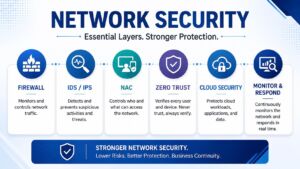
Key Components of Network Security
1. Firewall and Network Firewall Security
A firewall monitors and controls incoming and outgoing network traffic based on security rules. Modern network firewall security can include traffic inspection, application controls, access policies, and threat prevention.
2. Intrusion Detection and Prevention
An intrusion detection system (IDS) identifies suspicious network activity and generates alerts.
An intrusion prevention system (IPS) can go a step further by automatically blocking or preventing malicious traffic.
3. Network Admission Control
Network admission control (NAC) determines which users and devices can connect to a network and what level of access they should receive.
For example, an organization can restrict an unmanaged device or quarantine an endpoint that fails security requirements.
4. Zero Trust
Zero Trust operates on the principle of continuously verifying users, devices, and access requests rather than automatically trusting entities inside the network.
This approach supports least-privilege access and reduces unnecessary exposure.
5. Cloud Network Security
As organizations move applications and infrastructure to the cloud, cloud network security becomes increasingly important. It can include access control, segmentation, encryption, traffic monitoring, and workload protection.
Also read: PAM Solution: The Complete Guide to Privileged Access Management
Network Security Technologies at a Glance
| Technology | Primary Purpose | Example Use |
|---|---|---|
| Firewall | Control network traffic | Block unauthorized connections |
| IDS | Detect suspicious activity | Generate security alerts |
| IPS | Prevent malicious traffic | Block detected attacks |
| NAC | Control network access | Restrict non-compliant devices |
| Zero Trust | Verify access | Enforce least privilege |
| Cloud Security | Protect cloud environments | Secure workloads and traffic |
The Current Network Security Threat Landscape
Cyber threats are becoming more frequent and sophisticated. Check Point’s 2026 Cyber Security Report recorded an 18% year-over-year increase in cyberattacks, while ransomware activity increased 48%.
IBM’s 2026 X-Force Threat Intelligence Index also found that manufacturing remained the most targeted industry, followed by financial services and insurance. North America accounted for nearly one-third of observed attacks by geographic concentration.
Common cyber security threats include:
- Ransomware and malware
- Phishing and credential theft
- Denial-of-service attacks
- Network reconnaissance
- Unauthorized access
- Vulnerability exploitation
- Insider threats
- Compromised IoT devices
- Supply-chain attacks
Attackers increasingly combine multiple techniques. A compromised credential or vulnerability may provide initial access, followed by lateral movement toward critical systems.
Also read: Top 10 Cyber Security Threats in 2026 You Must Know
Network Security Best Practices
1. Segment the Network
Separate critical systems, applications, users, and sensitive resources. Segmentation can restrict lateral movement after an intrusion.
2. Apply Least-Privilege Access
Give users and devices only the access they need. Review permissions regularly and remove unnecessary privileges.
3. Monitor Network Activity
Continuous monitoring helps security teams identify unusual traffic, unauthorized connections, and suspicious behavior.
4. Patch Vulnerabilities
Because software vulnerabilities have become a leading breach entry point, organizations should prioritize timely patching and vulnerability management.
5. Secure Cloud and Remote Access
Use strong authentication, access controls, encryption, segmentation, and monitoring for remote users and cloud workloads.
6. Combine Security Controls
Firewalls, NAC, IDS/IPS, endpoint security, SIEM, and other technologies should work together instead of operating as isolated systems.
Network Security vs. Cybersecurity
Network security is a key component of the broader cybersecurity strategy.
Cybersecurity protects systems, applications, identities, networks, data, and digital operations, while network security focuses specifically on protecting network infrastructure, traffic, communications, and connected resources.
Organizations may also work with cyber security companies or a cyber security consultant to assess their environment and develop an appropriate security strategy.
Also read: Predictive Analysis in AIOps
How to Choose a Network Security Solution
Before selecting a solution, organizations should evaluate:
- Network size and complexity
- Cloud and on-premises infrastructure
- Number of connected devices
- Existing security integrations
- Real-time monitoring
- Automation capabilities
- Scalability
- Reporting requirements
- Total cost of ownership
The right solution should provide effective protection while aligning with the organization’s infrastructure and security objectives.
Also read: IAM: A Complete Guide to Identity and Access Management
Strengthen Network Access Security with CyberSIO tbNAC
Controlling which users and devices can access the network is an important part of network security. CyberSIO tbNAC provides network access control capabilities for enforcing access policies and improving endpoint visibility.
Key capabilities include:
- Intelligent auto-quarantine
- Centralized policy management
- Endpoint intelligence
- Continuous endpoint heartbeat
- Bulk switch onboarding
- Advanced patch management
By combining network admission control with endpoint visibility and policy enforcement, tbNAC can help organizations strengthen control over network access.
Explore CyberSIO tbNAC to learn more about network access control and endpoint security.
Final Takeaway
The latest cybersecurity data makes one thing clear: organizations cannot treat network security as a single firewall or perimeter-control problem. Vulnerability exploitation, supply-chain risks, ransomware, AI-enabled attacks, and increasingly distributed infrastructure require a layered security strategy.
Organizations should combine access control, segmentation, monitoring, vulnerability management, IDS/IPS, Zero Trust, and endpoint security to reduce exposure and respond faster to emerging threats.

Must Read Articles:
- Understanding Identity Threat Detection and Response (ITDR)
- Patch Management: Benefits, Challenges, and Best Practices for Modern IT Environments
- SOC as a Service vs In-House SOC
- Astra AI : Redefining the Modern SOC with Generative Intelligence
- Disinformation Security and Deepfake Detection
Frequently Asked Questions on Network Security
1. What is network security?
2. Why is network security important?
3. What are the main types of network security?
4. What are common network security threats?
5. How does NAC improve network security?
Sources for Metrics and Rankings:
The statistics and rankings used in this article are based on the following recent reports:
- Verizon — 2026 Data Breach Investigations Report (DBIR): breach entry points, software vulnerabilities, and third-party risks.
- IBM — 2026 Cost of a Data Breach Report: global breach costs and AI-enabled breach statistics.
- IBM — 2026 X-Force Threat Intelligence Index: most-targeted industries and geographic attack concentration.
- Check Point Research — Cyber Security Report 2026: year-over-year cyberattack and ransomware growth.
- IBM India — Cost of a Data Breach 2025: India-specific average breach cost and year-over-year increase.