Cybersecurity is entering a new era. Attackers are increasingly using AI to improve the speed and scale of cyberattacks, while security teams face growing alert volumes, complex IT environments, and limited resources.
This is where agentic AI in cyber security is gaining attention. Unlike traditional AI that mainly analyzes data or provides recommendations, agentic AI can understand objectives, reason through multiple steps, interact with security tools, and perform authorized actions with limited human intervention.
This article explains what agentic AI means for cybersecurity, its major use cases, current industry metrics, security risks, and how enterprises can adopt it responsibly.
See how CyberSIO helps strengthen your security posture: Schedule a Free Demo.
What Is Agentic AI in Cyber Security?
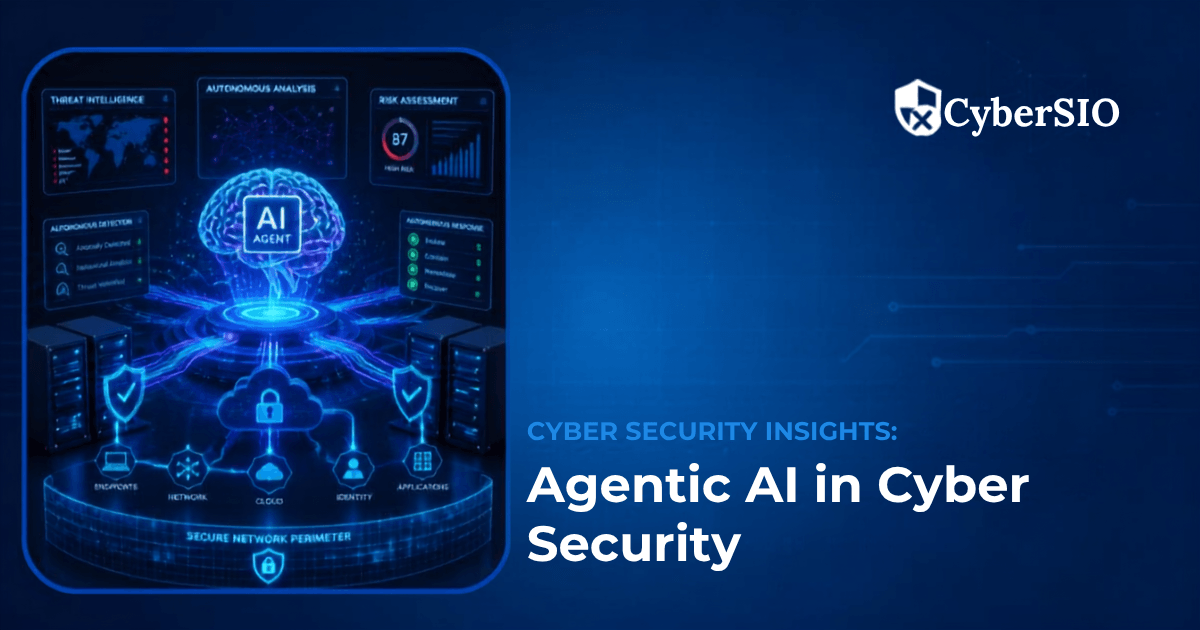
Agentic AI in cyber security refers to AI systems capable of pursuing security objectives by analyzing information, planning tasks, using connected tools, and taking controlled actions.
For example, when a suspicious login occurs, an AI agent could:
- Detect the anomaly.
- Investigate the user’s activity.
- Correlate endpoint and network events.
- Assess the risk.
- Query threat intelligence.
- Recommend or execute an approved response.
- Verify the result.
The key difference is autonomy. Traditional AI answers “What happened?” while agentic AI can potentially work toward “What should happen next?”
Agentic AI vs Traditional AI
| Capability | Traditional AI | Agentic AI |
| Threat detection | ✓ | ✓ |
| Data analysis | ✓ | ✓ |
| Recommendations | ✓ | ✓ |
| Multi-step reasoning | Limited | ✓ |
| Tool interaction | Limited | ✓ |
| Automated investigation | Limited | ✓ |
| Autonomous action | Limited | ✓ |
Why Agentic AI Matters for Cybersecurity
Modern enterprises generate enormous security telemetry from endpoints, networks, identities, cloud workloads, applications, and security platforms.
The challenge is not only detecting threats but investigating and responding quickly.
Agentic AI cybersecurity systems can connect multiple stages of security operations:
Detection → Investigation → Analysis → Decision → Response → Verification
This can reduce repetitive analyst work and potentially improve response speed.
Microsoft highlights agentic AI’s potential to automate repetitive cybersecurity tasks and reduce alert fatigue.
Also read: PAM Solution: The Complete Guide to Privileged Access Management
The Current Agentic AI Cybersecurity Landscape
The growth of AI-driven threats is reflected in recent industry research.
IBM’s 2026 Cost of a Data Breach research reported a 56% increase in AI-driven attacks compared with the previous year. It also reported an average cost of approximately $6 million for AI-driven breaches, compared with a global average breach cost of $4.99 million.
The same research found that organizations using AI and automation extensively in security operations achieved an average $1.93 million reduction in breach costs.
Key Metrics
| Metric | Finding |
| Increase in AI-driven attacks | 56% |
| Average global breach cost | $4.99M |
| Average AI-driven breach cost | ~$6M |
| Savings from extensive AI & automation | $1.93M |
| Organizations using AI agents for threat hunting, response & containment | 50% |
| Organizations using AI agents for vulnerability management | 18% |
These figures demonstrate both the growing threat and the opportunity for AI in cybersecurity.
Major AI Agents in Cybersecurity Use Cases
1. Threat Detection
AI agents can continuously analyze security signals and correlate suspicious activities across multiple systems.
For example:
Unusual login + endpoint anomaly + suspicious network connection = higher-risk investigation
This provides more context than evaluating isolated alerts.
2. Automated Investigation
An agent can collect information from SIEM, endpoint, identity, network, vulnerability, and threat-intelligence platforms.
It can then organize the evidence into an investigation timeline, reducing manual research for SOC analysts.
3. Incident Response
Depending on organizational policies, agents can:
- Enrich security alerts
- Identify affected assets
- Search for related indicators
- Recommend containment
- Trigger approved workflows
- Verify remediation
High-risk actions should remain subject to human approval.
4. Vulnerability Management
Agentic systems can prioritize vulnerabilities using factors such as:
- Severity
- Asset criticality
- Exploitability
- Exposure
- Threat intelligence
- Business impact
This allows teams to focus on vulnerabilities that represent the greatest real-world risk.
Also read: IAM: A Complete Guide to Identity and Access Management
Major Risks of Autonomous Cybersecurity
Greater autonomy also creates new attack surfaces.
OWASP identifies risks including goal hijacking, tool misuse, identity and privilege abuse, memory/context poisoning, and supply-chain vulnerabilities in agentic applications.
Key risks include:
- Prompt Injection: Attackers may manipulate information processed by an AI agent.
- Privilege Abuse: A compromised agent could misuse access to security tools or sensitive systems.
- Tool Misuse: Agents with powerful tools may perform unauthorized actions if controls fail.
- Memory Poisoning: Malicious information could influence future agent decisions.
- Supply-Chain Risk: Models, APIs, plugins, tools, and external services can introduce additional attack surfaces.
NIST also highlights AI agent hijacking as an emerging security concern requiring dedicated evaluation and testing.
Also read: Predictive Analysis in AIOps
How Enterprises Can Secure Agentic AI
Organizations should treat AI agents as non-human identities and apply strong security controls.
Key practices include:
- Implement least-privilege access.
- Use strong identity and authentication controls.
- Create approval gates for high-risk actions.
- Monitor agent activity continuously.
- Maintain complete audit logs.
- Test for prompt injection and agent hijacking.
- Validate third-party tools and integrations.
- Establish clear AI governance policies.
The goal should be controlled autonomy not unrestricted autonomy.
Also read: Top 10 Cyber Security Threats in 2026 You Must Know
AI Cybersecurity Solutions: What to Look For
When evaluating AI cybersecurity solutions, enterprises should look beyond claims of “autonomous AI.”
Look for:
- Security platform integration
- Identity and privilege controls
- Explainable decisions
- Policy enforcement
- Human oversight
- Comprehensive audit trails
- Automated investigation
- Controlled response
- Continuous monitoring
The best approach combines machine speed with human judgment.
The Future of Agentic AI in Cyber Security
The future may involve specialized AI agents working together across the security lifecycle.
- Threat Hunting Agent → Finds suspicious activity
- Investigation Agent → Correlates evidence
- Risk Agent → Prioritizes incidents
- Response Agent → Executes approved actions
- Compliance Agent → Documents activity
This model could transform traditional security operations into a more continuous and adaptive defense system.
However, autonomy must evolve alongside governance. NIST and OWASP both emphasize that agentic systems introduce security considerations that require dedicated controls and evaluation.
The Road Ahead for Agentic AI in Cyber Security
Agentic AI in cyber security represents an important evolution in modern security operations. By combining reasoning, automation, tool interaction, and controlled autonomy, AI agents can help organizations detect threats, investigate incidents, prioritize vulnerabilities, and accelerate response.
But greater autonomy also creates new risks. Enterprises should prioritize least privilege, identity security, human oversight, continuous monitoring, testing, governance, and auditability.
The future of cybersecurity may be increasingly autonomous, but the strongest security environments will combine AI-driven speed with human judgment, strong governance, and continuous security controls.

Must Read Articles:
- Understanding Identity Threat Detection and Response (ITDR)
- Patch Management: Benefits, Challenges, and Best Practices for Modern IT Environments
- SOC as a Service vs In-House SOC
- Astra AI : Redefining the Modern SOC with Generative Intelligence
- Disinformation Security and Deepfake Detection
FAQs on Agentic AI in Cyber Security
What is agentic AI in cybersecurity?
How is agentic AI different from traditional AI in cybersecurity?
What are the main use cases of agentic AI in cybersecurity?
What are the risks of using agentic AI in cybersecurity?