
What Is Network Detection and Response?
Network Detection and Response (NDR) is a cybersecurity technology that continuously monitors and analyzes network traffic to identify suspicious behavior, investigate threats, and support incident response.
Traditional security controls often focus on endpoints, known attack signatures, or perimeter traffic. NDR adds another layer of visibility by examining how users, devices, applications, servers, and workloads communicate across the network.
Modern NDR solutions combine network telemetry with behavioral analytics, machine learning, threat intelligence, and other detection techniques. They can identify abnormal activity even when an attack does not match a previously known signature. Gartner defines NDR around detecting abnormal network behavior through behavioral analytics applied to network traffic data.
This makes NDR particularly valuable for detecting activity that occurs after an attacker gains access.
See how CyberSIO helps strengthen your security posture: Schedule a Free Demo.
Why Network Detection and Response Matters
Today’s enterprise networks extend across data centers, branch offices, cloud platforms, remote users, IoT devices, and operational technology.
This creates more communication paths for attackers to exploit.
NDR provides visibility into both:
- North-south traffic: communication entering or leaving the environment
- East-west traffic: communication between internal systems
That second area is especially important because attackers may use compromised credentials or legitimate tools to move from one system to another.
Cisco highlights network-wide monitoring, behavioral modeling, machine learning, and analysis of lateral activity as important NDR capabilities.
Also read: PAM Solution: The Complete Guide to Privileged Access Management
How Does Network Detection and Response Work?
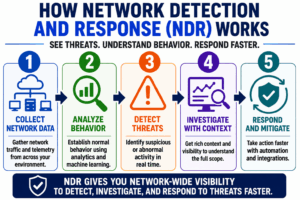
A modern NDR platform typically follows four stages.
1. Collect Network Telemetry
NDR collects information from sources such as network traffic, flow records, metadata, network infrastructure, and—in some platforms—packet captures.
Depending on the architecture, organizations can use technologies such as SPAN ports, network TAPs, flow data, or existing network infrastructure.
2. Establish Normal Behavior
The platform builds behavioral baselines for users, devices, applications, and network communications.
For example, a server normally communicating with five internal systems may suddenly begin communicating with hundreds of devices. That deviation can become a detection signal.
3. Detect Suspicious Activity
NDR combines behavioral analytics, machine learning, rules, threat intelligence, and other analytical techniques to identify potentially malicious behavior.
Common examples include:
- Command-and-control communication
- Network reconnaissance
- Port scanning
- Lateral movement
- Privilege-related anomalies
- Data exfiltration
- Unauthorized communications
- Malware-related network behavior
Palo Alto Networks identifies command-and-control, lateral movement, exfiltration, malware, targeted attacks, insider activity, and risky behavior among the types of activity NDR can uncover.
4. Investigate and Respond
Detection is only useful when analysts can understand what happened.
NDR should provide context around affected devices, communications, timelines, and attack paths. It can then support manual investigation or integrate with other technologies to automate response.
Also read: Astra AI : Redefining the Modern SOC with Generative Intelligence
What Threats Can NDR Detect?
NDR is particularly useful for threats that generate suspicious network behavior.
1. Unknown and Evasive Malware
Attackers increasingly use techniques designed to avoid signature-based detection. Behavioral analysis can identify unusual communications even when the specific malware is unknown.
2. Lateral Movement
After compromising one system, attackers often attempt to reach other systems.
NDR can identify unusual internal communication patterns, scanning, authentication-related anomalies, and other indicators of lateral movement.
3. Command and Control
Compromised systems may communicate with attacker-controlled infrastructure. NDR can identify unusual external destinations and communication patterns associated with command-and-control activity.
4. Data Exfiltration
Unusual outbound data transfers can indicate an attempt to steal sensitive information.
5. Insider and Risky Behavior
Not every threat begins with external attackers. Abnormal network activity from legitimate accounts or internal systems can also indicate compromised credentials, insider misuse, or risky behavior.
Also read: Disinformation Security and Deepfake Detection
NDR vs EDR vs MDR
These technologies are complementary rather than interchangeable.
| Technology | Primary Visibility | Main Role | Typical Value |
|---|---|---|---|
| NDR | Network traffic and communications | Detect network-based threats | Network-wide behavioral visibility |
| EDR | Endpoints, processes and files | Detect endpoint threats | Deep device-level investigation |
| MDR | Managed security data sources | Monitoring, investigation and response | Security expertise and continuous operations |
An endpoint detection and response solution focuses on activity occurring directly on endpoints.
NDR focuses on the communication between systems.
MDR in cyber security is different because it is generally a managed service that provides continuous monitoring, investigation, threat hunting, and response support. Gartner’s current MDR market information includes services monitoring environments such as networks, endpoints, and cloud infrastructure.
The strongest security architecture can use all three where appropriate.
Also read: Predictive Analysis in AIOps
NDR Deployment Models
Organizations can select an NDR architecture based on infrastructure, security requirements, and operational preferences.
1. On-Premises NDR
Useful for organizations that require greater control over network telemetry, data retention, and infrastructure.
2. Cloud-Based NDR
Cloud-based NDR can simplify deployment and provide centralized monitoring across distributed environments.
3. Hybrid NDR
Hybrid deployment combines on-premises and cloud visibility and can be useful for organizations operating across multiple environments.
Fortinet, for example, currently offers both cloud and on-premises NDR approaches and highlights coverage across IT, OT, IoT, and hybrid environments.
Key NDR Capabilities to Evaluate
Not every NDR solution provides the same level of visibility or investigation.
Before selecting an NDR platform, evaluate:
1. Network Visibility
Can it monitor north-south and east-west traffic across your environment?
2. Behavioral Detection
Does it establish baselines and identify deviations rather than depending only on signatures?
3. Threat Intelligence
Can the platform enrich network detections with current threat intelligence?
4. Investigation and Forensics
Can analysts reconstruct activity, investigate attack paths, and understand affected systems?
5. Encrypted Traffic Visibility
Can the platform identify suspicious behavior within encrypted communications without creating unnecessary operational complexity?
6. Response Automation
Can detections trigger actions through SIEM, SOAR, firewalls, EDR, or other security controls?
7. Scalability
Can the solution handle your network volume, cloud expansion, distributed locations, and future growth?
NDR and the Modern SOC
NDR should not operate as an isolated security tool.
Its greatest value comes when network intelligence is correlated with other security telemetry.
Integration with SIEM, SOAR, EDR, XDR, firewalls, threat intelligence, and identity systems can give analysts broader context.
For example, an NDR platform may detect suspicious communication, an EDR platform can identify the process responsible, and a SOAR platform can automate containment.
This reduces investigation time and helps security teams move from detection → investigation → response more efficiently.
Recent NDR Rankings and Market Reports
NDR remains an active and evolving cybersecurity market.
Gartner’s 2026 Magic Quadrant for Network Detection and Response is dated May 18, 2026. Gartner’s current NDR research also lists products and vendors including Vectra AI, ExtraHop, Darktrace, Stellar Cyber, ThreatBook, Gatewatcher, Cisco Secure Network Analytics, LinkShadow, Sangfor, Hillstone, and others on its Peer Insights market page.
Importantly, these should not be treated as a simple “best vendor” ranking. Gartner’s market definition emphasizes capabilities such as behavioral detection, network traffic analysis, anomaly detection, and automated response. Organizations should therefore evaluate vendors against their own network architecture and SOC requirements.
For buyers researching NDR Gartner reports or network detection and response vendors, the latest analyst research should be combined with hands-on product evaluation, deployment requirements, integrations, scalability, and total cost.
Also read: Top 10 Cyber Security Threats in 2026 You Must Know
The Future of Network Detection and Response
NDR is evolving from network monitoring into a broader source of security intelligence.
AI-assisted investigation, behavioral analytics, cloud visibility, automated response, and integration with wider security operations are becoming increasingly important.
The direction is clear: security teams need more than alerts. They need context, prioritization, investigation, and response.
As organizations adopt hybrid infrastructure and face increasingly evasive attacks, NDR can provide the network-level visibility needed to identify suspicious behavior that endpoint or perimeter controls may not see.
Also read: Patch Management Software: The Complete Enterprise Guide for 2026
Why NDR Should Be Part of Your Security Strategy
Network detection and response gives organizations another critical perspective on cyber threats: how everything communicates.
By continuously analyzing network behavior, NDR can help identify command-and-control activity, lateral movement, reconnaissance, abnormal communications, and potential data exfiltration.
The strongest NDR strategy is not about replacing EDR, SIEM, SOAR, or MDR. It is about connecting network intelligence with these technologies to create a more complete detection and response capability.
For organizations evaluating NDR solutions in 2026, prioritize network visibility, behavioral detection, investigation depth, integrations, deployment flexibility, scalability, and response automation.
The goal is simple: detect suspicious behavior earlier, understand the attack faster, and respond before it becomes a larger security incident.

Must Read Articles:
- Understanding Identity Threat Detection and Response (ITDR)
- What Is Network Access Control (NAC)?
- Patch Management: Benefits, Challenges, and Best Practices for Modern IT Environments
- SOC as a Service vs In-House SOC
- IAM: A Complete Guide to Identity and Access Management
Frequently Asked Questions on Network Detection and Response
What is Network Detection and Response (NDR)?
How does Network Detection and Response work?
What is the difference between NDR and EDR?
What is the difference between NDR and MDR in cybersecurity?
