Artificial intelligence is rapidly transforming how organizations approach cyber defense. While attackers increasingly leverage automation and machine intelligence to scale attacks, security teams are adopting AI-driven cyber security technologies to detect, investigate, and respond faster than ever before.
The latest developments in cybersecurity AI show that the conversation is no longer about whether organizations should adopt AI, but rather how they can use it securely and effectively. This article explores the most important AI and cybersecurity trends shaping 2026 and what security leaders should prepare for next.
See how CyberSIO helps strengthen your security posture: Schedule a Free Demo.
Why AI in Cybersecurity Matters More Than Ever
The role of AI in cyber security has expanded significantly due to several factors:
- Increasing attack complexity
- Growing alert volumes
- Shortage of cybersecurity professionals
- Expansion of cloud and hybrid environments
- Rising adoption of generative AI cybersecurity tools
Industry forecasts indicate that global cybersecurity investments continue to grow rapidly as organizations strengthen defenses against AI-enhanced threats.
Key Takeaway: AI is becoming both the greatest cybersecurity challenge and one of the most powerful defensive capabilities available today.
Also read: PAM Solution: The Complete Guide to Privileged Access Management
Agentic AI Is Transforming Both Attack and Defense
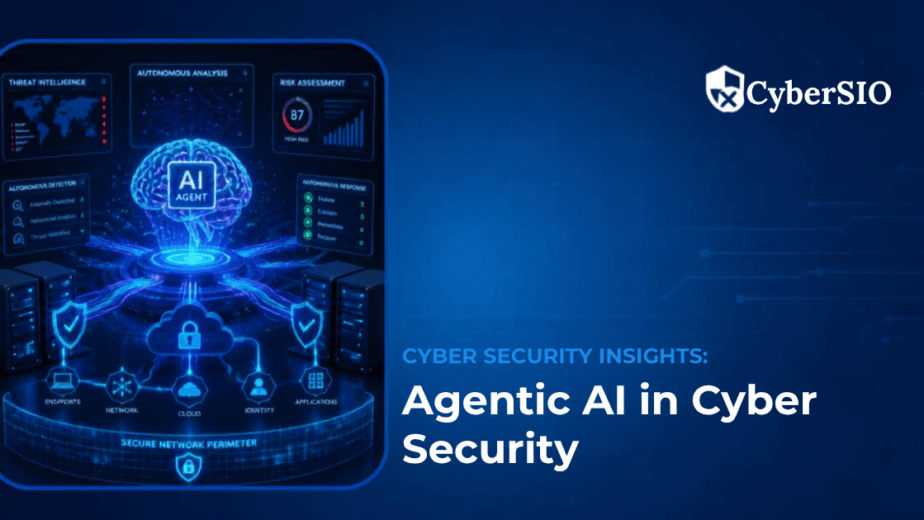
One of the biggest trends in cybersecurity with AI is the emergence of agentic AI systems. These autonomous agents can independently perform complex tasks, creating opportunities and risks simultaneously.
On the defensive side, organizations are deploying autonomous security agents to:
- Investigate alerts automatically
- Correlate threat intelligence
- Accelerate incident response
- Reduce analyst fatigue
However, attackers are also using AI agents to automate:
- Vulnerability discovery
- Reconnaissance
- Social engineering campaigns
- Phishing personalization
This evolution is creating an unprecedented cybersecurity arms race.
Also read: Astra AI : Redefining the Modern SOC with Generative Intelligence
AI-Powered Security Operations Centers Become Mainstream
AI cybersecurity technologies are reshaping Security Operations Centers (SOCs). Traditional SOC teams often struggle with alert overload and slow investigations.
Modern AI-driven SOC capabilities include:
- Automated alert triage
- Behavioral anomaly detection
- Threat prioritization
- Attack path analysis
- Investigation assistance
These capabilities help organizations improve detection accuracy while reducing response times.
The Rise of AI Identity and Authorization Challenges
As organizations adopt agentic AI, cybersecurity in AI environments is becoming increasingly complex.
Key identity-related challenges include:
- Machine identity management
- Agent authorization controls
- Privileged access monitoring
- AI decision accountability
- Policy enforcement across autonomous systems
Security teams are now rethinking traditional identity frameworks to accommodate AI-powered environments.
Deepfake Detection and Content Authenticity Take Center Stage
Generative AI cybersecurity concerns continue to rise as synthetic media becomes increasingly sophisticated.
Organizations are investing in technologies that can detect:
- AI-generated voice impersonation
- Synthetic video manipulation
- Fraudulent communications
- Altered digital documents
- Fake identity verification attempts
Content authenticity validation is expected to become a critical component of enterprise security programs.
Also read: Disinformation Security and Deepfake Detection
Shadow AI Creates New Governance Risks
One of the fastest-growing risks in artificial intelligence and security comes from unsanctioned AI usage inside organizations.
Common shadow AI risks include:
- Unauthorized AI tools
- Sensitive data exposure
- Compliance violations
- Poor governance controls
- Unmanaged third-party integrations
Strong AI governance frameworks are becoming essential to reduce organizational risk.
Predictive Vulnerability Management Gains Momentum
Traditional vulnerability management often overwhelms security teams with thousands of alerts.
AI in cybersecurity is changing this through predictive prioritization, which analyzes:
- Exploit likelihood
- Threat intelligence trends
- Attack activity patterns
- Asset criticality
- Historical attack behavior
This enables organizations to prioritize vulnerabilities most likely to be exploited.
Also read: Predictive Analysis in AIOps
AI Red Teaming Becomes a Security Requirement
As AI adoption accelerates, organizations are increasingly conducting AI red team exercises to identify vulnerabilities before attackers do.
AI red teaming typically includes:
- Adversarial testing
- Prompt manipulation assessments
- Model abuse simulations
- Data poisoning tests
- Security control validation
This proactive approach helps improve AI system resilience.
AI-Assisted Cybercrime Continues to Evolve
Cybercriminals are increasingly commercializing AI-enabled attack techniques.
Examples include:
- Automated phishing generation
- Social engineering playbooks
- Malware development assistance
- Credential harvesting automation
- AI-assisted reconnaissance
This commercialization significantly lowers the barrier to entry for cyber attackers.
Supply Chain and Public-Facing Application Risks Increase
Organizations continue to experience growing risks from public-facing applications and software supply chains.
Artificial intelligence in security is helping organizations:
- Identify attack patterns
- Detect anomalies faster
- Analyze software dependencies
- Prioritize remediation efforts
- Improve threat visibility
Supply chain security remains one of the highest priorities for modern cybersecurity programs.
Key AI Cybersecurity Metrics to Watch in 2026
| Metric | 2026 Trend |
| Global cybersecurity spending | Projected to exceed $240 billion |
| Security leaders concerned about AI threats | 87% |
| Leaders concerned about AI agents | 92% |
| Exploitation of public-facing applications | Increased by 44% YoY |
| AI SOC adoption | Rapid enterprise expansion |
| AI governance investments | Significant growth globally |
The Future of AI in Cybersecurity
The future of cyber AI will be defined by how effectively organizations balance innovation, security, and governance. From agentic AI and autonomous SOC operations to deepfake detection and predictive vulnerability management, AI in cybersecurity is fundamentally changing both offensive and defensive security strategies.
Organizations that proactively invest in AI security controls, governance frameworks, and continuous testing will be better positioned to manage emerging threats. As artificial intelligence and security continue to evolve together, staying informed about these trends will be critical for building resilient cybersecurity programs.

Must Read Articles:
- Understanding Identity Threat Detection and Response (ITDR)
- What Is Network Access Control (NAC)?
- Patch Management: Benefits, Challenges, and Best Practices for Modern IT Environments
- SOC as a Service vs In-House SOC
- IAM: A Complete Guide to Identity and Access Management
Frequently Asked Questions About AI in Cybersecurity
What is AI in Cybersecurity?
AI in cybersecurity refers to the use of artificial intelligence technologies to detect, prevent, analyze, and respond to cyber threats more efficiently and accurately.
How Is AI Used in Cybersecurity?
AI is used in cybersecurity for threat detection, incident response, vulnerability management, behavioral analysis, fraud prevention, and security automation.
Can AI Replace Cybersecurity Professionals?
No, AI cannot replace cybersecurity professionals; it enhances their capabilities by automating repetitive tasks and accelerating threat investigations.
What Are the Benefits of AI-Driven Cybersecurity?
AI-driven cybersecurity improves threat detection accuracy, reduces response times, minimizes alert fatigue, and helps organizations proactively identify risks.
What Are the Latest Developments in AI and Cybersecurity?
The latest developments in AI and cybersecurity include agentic AI, AI-powered SOCs, deepfake detection, predictive vulnerability management, and AI red teaming.
Sources:
- Fortinet – https://www.fortinet.com/resources/cyberglossary/cybersecurity-trends-2026
- Darktrace – https://www.darktrace.com/resource/the-state-of-ai-cybersecurity-2026
- ISACA – https://www.isaca.org/resources/news-and-trends/industry-news/2026/the-6-cybersecurity-trends-that-will-shape-2026
- IBM X-Force – https://www.ibm.com/think/insights/more-2026-cyberthreat-trends
- Seceon – https://seceon.com/cybersecurity-trends-2026/
- Splashtop – https://www.splashtop.com/blog/top-cybersecurity-trends-and-predictions-for-2026
- EC-Council University – https://www.eccu.edu/blog/cybersecurity-trends-2026/
- Deloitte – https://www.deloitte.com/ce/en/industries/technology/analysis/balancing-innovation-and-risk-how-ai-is-reshaping-cybersecurity.html
- SentinelOne – https://www.sentinelone.com/cybersecurity-101/data-and-ai/ai-cybersecurity-trends/